
IPA vs TPM for Industrial Resin 3D Printing: Solvent Guide
Isopropyl alcohol (IPA) is fast and familiar, yet its low flash point and high evaporation rate often trigger fire-safety limits once a factory scales up resin printing. This guide compares IPA against TPM and DPM on EHS compliance, bath life, rinse steps, and part surface finish so engineering and facilities teams can pick a solvent that fits their floor constraints.
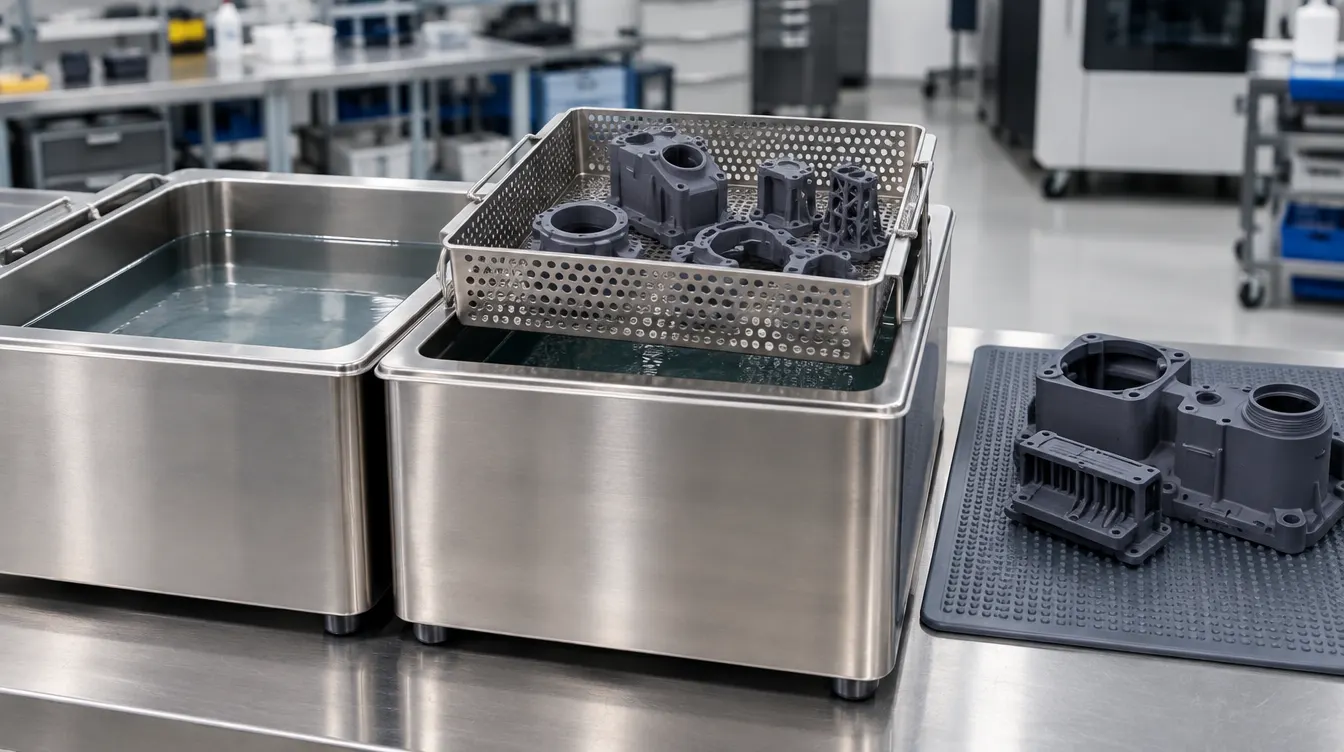
Scaling resin 3D printing turns solvent selection into a combined process-engineering and EHS compliance decision.
Direct Answer: Choose IPA for industrial resin 3D printing when your facility already permits flammable-liquid storage and ventilation, and you prioritize fast drying with a simple single-solvent workflow. Switch to TPM (tripropylene glycol monomethyl ether) when EHS fire codes restrict bulk flammable liquids, because TPM has a much higher flash point, low odor, and longer bath life before saturation. However, TPM does not evaporate cleanly on its own—it requires a thorough secondary water or clean-solvent rinse and forced drying before UV post-curing. DPM sits between the two, offering faster evaporation than TPM and lower flammability than IPA, while still requiring careful soak-time control.
The comparisons below reflect general industrial photopolymer post-processing practice alongside YIDIMU workflow documentation; always confirm flammability classifications, ventilation requirements, and disposal rules against the supplier's Safety Data Sheet (SDS) and local regulations.
Key Takeaways
IPA evaporates fast and leaves dry parts quickly, but its low flash point and vapor emissions create storage, grounding, and exhaust hurdles in larger print rooms.
TPM solves most flammable-liquid storage caps and slows evaporation loss, but skipping the secondary rinse leaves a waxy or slick film that stays tacky after UV curing.
DPM dissolves viscous resins aggressively and carries a higher flash point than IPA, though prolonged soaking can soften thin walls or fine features on sensitive resins.
No solvent eliminates hazardous waste disposal—rinse water containing uncured resin and glycol ether must still be captured and handled under local waste rules, never poured down a drain.
Regardless of solvent choice, a two-stage wash (dirty pre-wash plus clean finish wash) cuts solvent consumption and keeps surface residue off finished parts.
Solvent Terms Used in EHS and Post-Processing Reviews
Flash point: The lowest temperature at which a liquid produces enough vapor near its surface to ignite if exposed to an ignition source. Facilities and insurance auditors use flash point—listed on every solvent SDS—to decide whether a room needs flammable storage cabinets, explosion-proof ventilation, or strict volume caps.
Evaporation rate and VOC load: How quickly a solvent transitions from liquid to airborne vapor at room temperature. High evaporation speed shortens part drying time, yet it also increases solvent top-up loss from open tanks and raises workplace vapor concentrations that require local exhaust.
Bath saturation (resin loading): The point at which dissolved uncured photopolymer builds up in the wash tank until the solvent can no longer strip fresh resin cleanly from part surfaces. Saturated baths leave sticky patches, cloudy films, or white powdery deposits once the part dries and enters UV post-curing.
Secondary rinse step: A follow-up wash—usually clean water for water-miscible glycol ethers like TPM, or a fresh solvent bath for IPA—used to remove the thin layer of high-boiling solvent left behind after the primary wash so the part dries completely before curing.
Why Do Factories Outgrow IPA in Multi-Printer Rooms?
IPA works well for one or two printers, but scaling to continuous or low-volume resin 3D printing production quickly exposes its fire-safety and evaporation limits. Because high-purity IPA is classified as a flammable liquid with a low flash point, EHS teams typically cap how many liters can sit outside rated safety cabinets.
Open wash tanks, ultrasonic cleaners that warm the bath during long cycles, and ungrounded plastic pumps all raise red flags during a safety audit. Even when fire compliance is met, rapid evaporation means operators spend time topping up tanks and managing strong alcohol odors unless dedicated exhaust hoods are installed over every wash station.
On the shop floor, IPA also ages faster than many teams expect. Once resin concentration climbs in a single-tank setup, parts come out looking clean while wet, then turn chalky white across recessed corners and internal channels after drying—a clear sign that dissolved resin precipitated back onto the surface.
How Do IPA, TPM, and DPM Compare on the Shop Floor?
Each solvent trades off flammability against drying speed and post-wash handling. Use the decision matrix below to weigh EHS requirements against daily operator cycle time.
| Decision Criterion | IPA (Isopropyl Alcohol) | TPM (Tripropylene Glycol Monomethyl Ether) | DPM (Dipropylene Glycol Monomethyl Ether) |
|---|---|---|---|
| Flammability / EHS profile | Flammable liquid (low flash point); strict storage, grounding, and ventilation rules | High flash point; generally outside standard flammable-liquid caps (confirm via SDS) | Combustible with higher flash point than IPA, lower than TPM (confirm via SDS) |
| Evaporation & odor | Very fast evaporation; strong odor; noticeable tank evaporation loss | Very slow evaporation; mild odor; minimal evaporation loss from tanks | Moderate-to-slow evaporation; mild ether odor; lower loss than IPA |
| Drying workflow | Air-dries quickly after compressed-air blow-off | Does not air-dry cleanly alone; requires water rinse plus forced air or warm drying | Slower than IPA; benefits from compressed-air blow-off and extended drying or rinse |
| Bath life before saturation | Shorter; tends to cloud and leave white residue earlier under heavy resin load | Longer; holds higher dissolved resin load before cleaning performance drops | Longer than IPA; strong solvency on viscous engineering resins |
| Part surface & swelling risk | Low risk in short washes; over-soaking can whiten or micro-crack thin walls | Low cracking risk; leaves oily/waxy film if secondary water rinse is skipped | Aggressive solvency; can soften thin features or elastomeric resins if over-soaked |
Notice that TPM is not a drop-in swap for IPA if you keep the exact same bench routine. Teams that pour TPM into a single wash bucket and send parts straight to air drying usually complain within the first week that parts feel greasy and stay tacky after UV post-curing. The solvent itself did its job; the missing step is rinsing off the low-volatility glycol ether film before the part enters the curing chamber.
How Does Solvent Choice Change Your Rinse and Drying Workflow?
The right solvent only produces clean, dimensionally stable parts when paired with a wash-and-dry sequence matched to its evaporation speed. Pulling a part straight from a wash tank into a UV chamber traps solvent on the surface, causing hazy patches, soft skins, or post-cure warping.
Two-stage washing works across all three solvents
Split washing into Stage 1 (a dirty pre-wash tank that strips bulk uncured resin) and Stage 2 (a clean finish tank that removes the remaining film). As Stage 2 begins to accumulate resin, rotate it into the Stage 1 position and refill Stage 2 with fresh solvent. This simple rotation extends usable bath life and directly lowers ongoing consumables spend—a factor worth tracking alongside industrial resin 3D printer maintenance costs.
Adding the water rinse for TPM
Because TPM is water-miscible and evaporates slowly, add a Stage 3 clean water rinse—ideally with gentle agitation or a soft brush for blind holes and lattice channels—followed by compressed-air blow-off. Allow the rinsed parts to dry fully before UV exposure; for practical checks on surface readiness, follow a structured check on when resin prints are dry enough to cure.
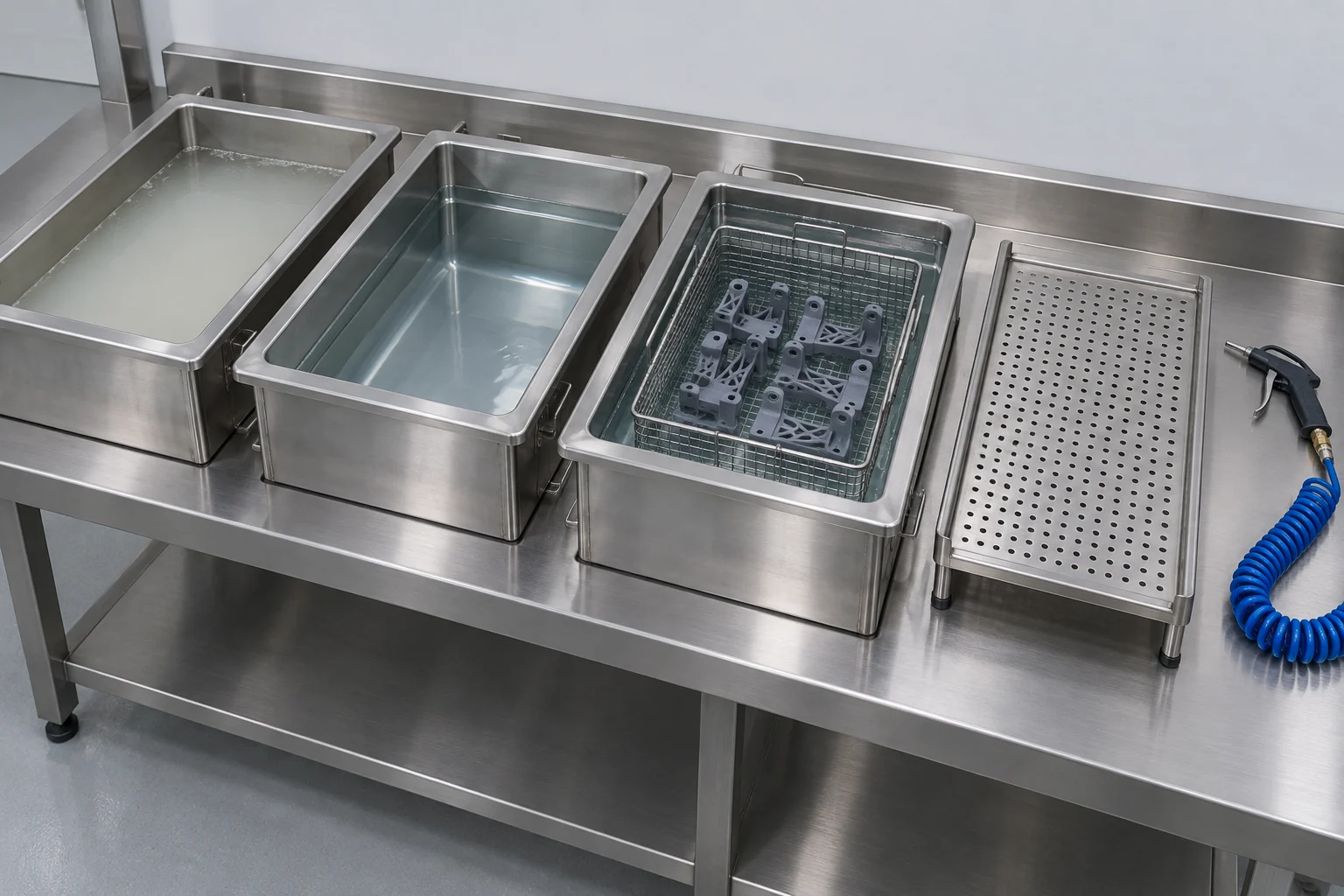
A staged wash-rinse-dry bench prevents saturated solvent from carrying uncured resin film into the UV post-curing chamber.
Where water-washable resins fit in
If your EHS policy rejects both flammable alcohols and glycol ether disposal streams, water-washable resins offer another route for general prototypes. Keep in mind that water-washable formulations carry their own trade-offs in moisture sensitivity, mechanical properties, and contaminated rinse-water containment; review water-washable resin vs. standard resin before committing a full product line to water-only washing.
What About Resin Compatibility, Elastomers, and Waste Disposal?
Solvent compatibility varies noticeably across rigid engineering resins, clear resins, dental resins, and flexible elastomers, so never switch an entire print room without testing each active material first.
Rigid and ABS-like engineering resins: Generally tolerate short IPA and TPM washes well. Watch for surface softening or edge rounding if parts sit unattended in DPM for extended soak periods.
Flexible and elastomeric resins: Thin lattice struts and soft elastomers absorb aggressive solvents quickly, which can cause temporary swelling, tearing during support removal, or surface tackiness. Keep wash times brief and verify rebound behavior after full drying and post-curing.
Clear and optical-grade resins: Saturated IPA often leaves a cloudy haze that is difficult to polish out later, while poorly rinsed TPM can leave streaks. Fresh Stage 2 solvent and spotless drying matter most here.
Waste handling across all options: Neither TPM nor water-washable rinse water is drain-safe once loaded with uncured photopolymer resin. Capture spent solvent and contaminated rinse water in labeled chemical waste drums for licensed disposal, or follow your facility's approved evaporation/filtration protocol.
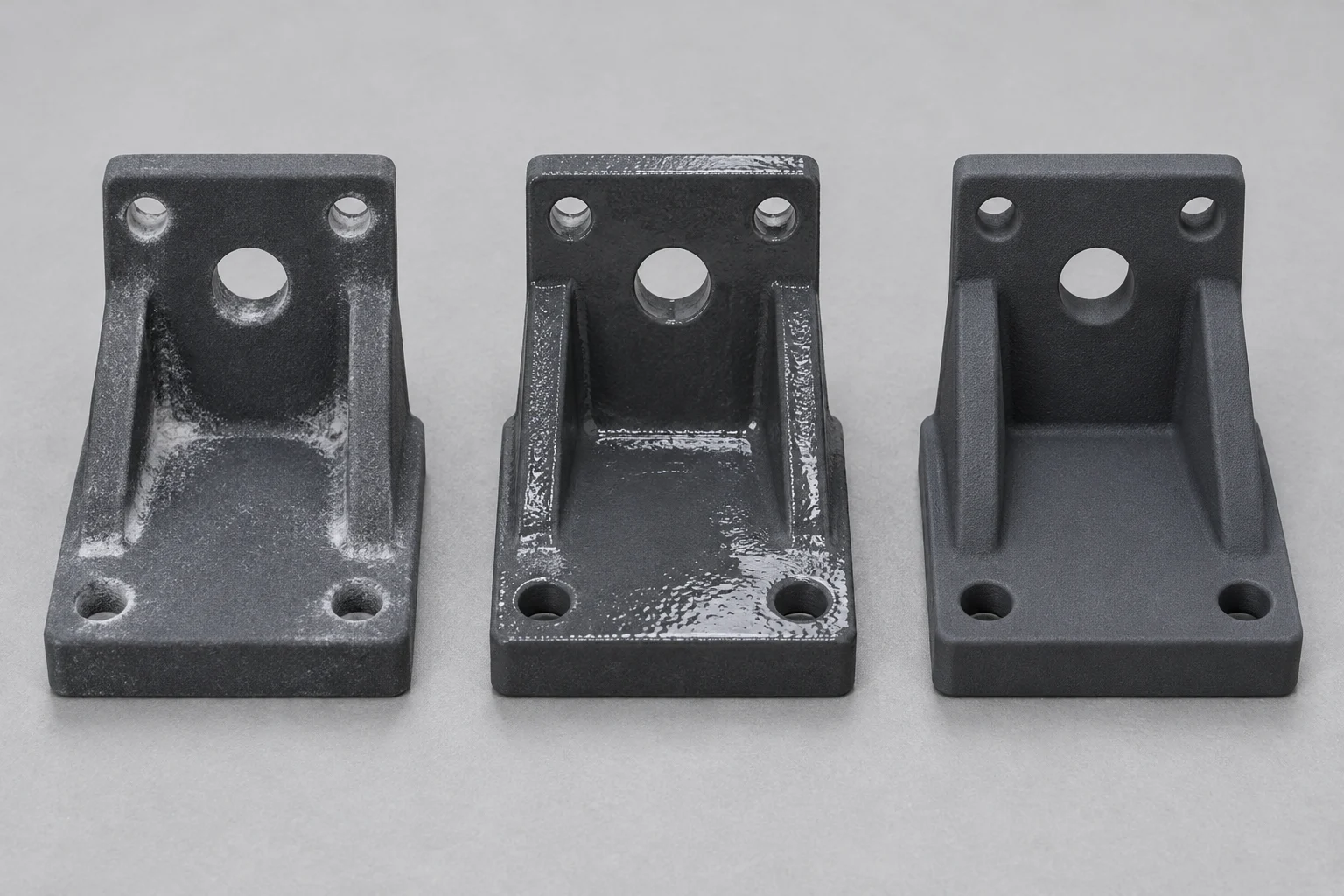
Surface appearance after UV post-curing reveals wash issues immediately: saturated IPA leaves white chalking, while unrinsed TPM leaves a glossy, tacky film.
Shop-Floor Solvent Qualification Template
Before ordering drums of a new solvent, print identical test parts containing thin walls, blind holes, and flat mating surfaces in each resin you run. Wash them side by side and record the results in the template below.
| Trial ID | Resin Formulation | Solvent & Wash Stages | Total Soak Time | Rinse & Dry Method | Surface Feel After UV Cure (Dry / Tacky / Chalky) | Dimensional Shift or Swelling Notes |
|---|---|---|---|---|---|---|
| Trial 1 | ||||||
| Trial 2 | ||||||
| Trial 3 | ||||||
| Trial 4 |
How to Read Your Solvent Trial Results
A qualified wash workflow produces a uniform matte or resin-typical finish with zero sticky zones inside blind holes, no white powder in corners, and no measurable swelling on thin walls after full drying and post-curing.
If a TPM-washed part feels slightly slick or stays tacky after UV curing, test adding a warm water rinse and longer compressed-air drying before rejecting TPM as incompatible. If a DPM- or IPA-washed part develops hairline micro-cracks around sharp corners or thin ribs, shorten the soak time first—excess dwell time in aggressive solvent is more often the cause than the printer or resin batch.
Common Mistakes When Switching Washing Solvents
Treating TPM as a no-rinse drop-in replacement for IPA. Why it fails: TPM has a very low evaporation rate, so residual solvent sits on the part surface and inhibits clean UV curing, leaving a tacky skin. What to do instead: Build a dedicated water rinse and forced-air drying step into your post-processing SOP whenever using TPM.
Running IPA in an unrated heated ultrasonic cleaner. Why it fails: Ultrasonic agitation heats the liquid and generates dense flammable alcohol vapor near electrical components, creating a serious fire hazard. What to do instead: Use explosion-rated equipment or indirect sealed-bag washing for IPA, or move to a higher-flash-point solvent approved by your EHS team.
Assuming "non-flammable" or "water-washable" means drain-safe. Why it fails: Dissolved uncured photopolymer monomers and photoinitiators remain hazardous to aquatic environments regardless of the carrier liquid. What to do instead: Collect all contaminated solvent and rinse water as regulated chemical waste according to local rules.
Over-soaking parts overnight to compensate for a saturated bath. Why it fails: Extended immersion swells cured resin, weakens thin walls, and still leaves suspended resin particles coated over the part. What to do instead: Keep soak cycles short and rotate fresh solvent into Stage 2 on a tracked schedule.
Limitations and Validation
This guide compares general chemical behavior and shop-floor trade-offs, not site-specific regulatory compliance. Local fire codes, insurance policies, and municipal wastewater rules vary widely by region, and specific resin formulations—especially medical, dental, or specialty elastomeric grades—may mandate a single validated washing solvent to maintain their published properties.
Before standardizing on IPA, TPM, or DPM, review the solvent SDS with your EHS officer, run the side-by-side coupon trial across every resin in your active library, measure critical dimensions before washing and 24 hours after UV post-curing, and confirm that your waste hauler accepts the resulting spent-solvent and rinse-water mix.
Relevant YIDIMU Systems and Post-Processing Equipment
Consistent washing only delivers repeatable part properties when paired with controlled post-curing and materials matched to your facility's cleaning setup:
UV Curing Box for 3D Printed Resin Models: Designed for uniform secondary UV post-curing after parts are thoroughly washed and dried, helping engineering and production prints reach stable mechanical and surface properties.
SX1000 Water-Washable 3D Printing Resin: An option for industrial models and prototypes where facilities want to minimize organic solvent handling on the bench while still following proper rinse-water containment.
Eternal M2 Large-Format Industrial Resin 3D Printer: A large-format industrial LCD masked-exposure (MSLA) system suited to batch builds and large prototypes where two-stage solvent planning and post-processing throughput directly affect daily output.
Solvent Selection & EHS Setup Checklist
Review the solvent SDS with EHS for flash point, ventilation, PPE, and on-site volume caps before purchasing.
Set up a two-stage wash (dirty pre-wash plus clean finish wash) regardless of whether you choose IPA, TPM, or DPM.
Include a clean water rinse and forced-air drying station whenever deploying TPM.
Verify resin compatibility with a side-by-side coupon trial across rigid, clear, and elastomeric materials.
Check parts for complete dryness—especially inside blind holes and lattices—before loading the UV curing chamber.
Track bath saturation by part count or hydrometer/clarity checks rather than waiting for chalky surface defects.
Store spent solvent and contaminated rinse water in labeled, closed containers for licensed hazardous-waste disposal.
Frequently Asked Questions
Is TPM safer than IPA for industrial resin 3D printing?
From a fire-safety standpoint, yes. TPM has a significantly higher flash point and much lower vapor pressure than IPA, which helps factories stay below flammable-liquid storage limits and reduces airborne solvent odor. Operators still need nitrile gloves, eye protection, and proper waste disposal, as TPM and dissolved resin remain chemical hazards.
Why do TPM-washed resin parts feel oily or sticky?
TPM evaporates very slowly at room temperature, so it does not flash off the part surface the way IPA does. If you skip the secondary water rinse—or fail to dry the rinsed part completely before UV post-curing—a thin film of glycol ether remains on the surface and leaves the cured part feeling slick or tacky.
Can you use TPM in an ultrasonic cleaner for resin prints?
In many facilities, TPM is preferred over IPA for ultrasonic baths because its higher flash point reduces vapor-ignition risk when agitation warms the liquid. Always confirm ultrasonic compatibility and maximum bath temperature on both the solvent SDS and your cleaner manufacturer's safety documentation before operating.
How does DPM differ from TPM for washing 3D printed resin?
DPM evaporates faster than TPM and acts as a stronger solvent on viscous resins, while still carrying a higher flash point than IPA. The trade-off is a narrower soak-time window: leaving thin-walled or flexible resin parts in DPM too long can soften fine features or cause slight surface swelling.
Can TPM rinse water be poured down the factory drain?
No. Even though TPM mixes with water, the rinse bath picks up uncured photopolymer resin monomers and photoinitiators from the washed parts. Collect contaminated rinse water in sealed waste containers and dispose of it through your facility's approved industrial waste channel.
Planning a Production Resin Post-Processing Line?
Share your target resins, daily part volume, and facility EHS constraints with the YIDIMU applications team. We can help you align printer capacity, washing workflows, and UV post-curing equipment—and run sample builds on your CAD geometry to confirm surface finish before deployment. Request a Workflow Evaluation.