
Scientists 3D-Printed Entire Shoes: What Worked?
Can an entire shoe be 3D printed without relying on separately manufactured uppers, midsoles and outsoles? Researchers have tested that possibility with different lightweight and flexible materials—and the results reveal why making a wearable shoe is more complicated than producing an impressive-looking prototype.
A study published on November 2, 2026, inFashion and Textiles examined fully 3D-printed shoes manufactured using conventional and lightweight thermoplastic materials. Researchers Imjoo Jung and Sunhee Lee at Dong-A University in South Korea investigated how material characteristics and manufacturing conditions affected the mechanical behavior of complete printed footwear.
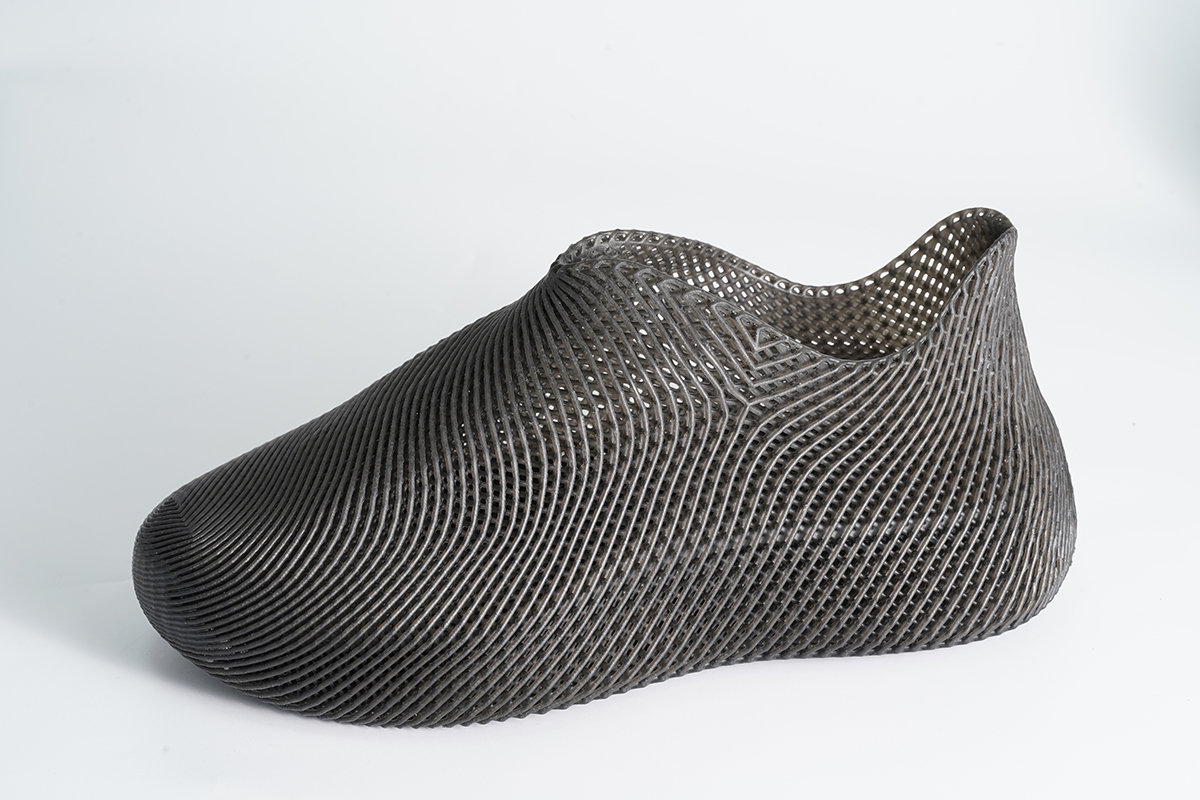
Their findings highlighted lightweight thermoplastic polyurethane (LW-TPU) as a promising candidate. The material combined low structural stiffness, substantial compressive deformation and a lightweight porous structure in the tested shoe design.
The key finding: A successful 3D-printed shoe depends on the interaction between material, internal structure, manufacturing process and mechanical performance. Flexibility alone does not establish whether a shoe will provide adequate cushioning, stability or durability.
A New Study Looks Beyond 3D-Printed Soles
Most footwear research involving additive manufacturing has focused on individual components, particularly insoles, midsoles and cushioning structures. Complete 3D-printed shoes introduce additional challenges because the upper and load-bearing regions must function as an integrated structure.
An entire printed shoe needs to accommodate foot insertion, deform under body weight, maintain its intended shape and tolerate repeated movement. It must also be manufacturable without unacceptable defects or damage during support removal.
Instead of evaluating only small material specimens, the new study connected filament characterization with complete shoe fabrication, mechanical testing and preliminary observations during walking.
How Were the Shoes Manufactured?
The researchers used dual-nozzle fused deposition modeling (FDM), an extrusion-based 3D printing process that deposits heated thermoplastic filament. Separate materials were used for the shoe body and temporary support structures.
The study compared three printed shoe configurations. Support materials were removed before the final shoe structures were evaluated.
| Shoe body | Support material | Observed characteristics |
|---|---|---|
| Lightweight PLA | PLA | A relatively rigid lightweight shoe structure with more limited flexibility. |
| TPU | Lightweight PLA | Flexible behavior and strong impact absorption associated with substantial deformation. |
| Lightweight TPU | PLA | Low stiffness, high compressive deformability, lightweight structure and controlled impact response. |
A particularly important feature of the lightweight filaments was their porous internal morphology. Pores created during the extrusion process remained observable in the printed structures, affecting how the shoe responded to loading.
Build orientation also mattered. The researchers used an inclined printing orientation to fit the full shoe geometry within the available build space. However, the study did not independently establish how that orientation affected final mechanical strength or dimensional accuracy.
What Did the Mechanical Tests Reveal?
1. Conventional TPU Absorbed Impact Through Deformation
The TPU shoe showed considerable flexibility and impact absorption associated with large deformation. This is useful for understanding how a soft printed structure responds when a load is applied.
However, a structure that deforms extensively is not automatically the best footwear design. Cushioning must be considered alongside stability, controlled displacement and recovery under repeated loading.
2. Lightweight TPU Offered a Different Balance
The LW-TPU shoe combined a porous structure with lower initial stiffness and substantial compressive deformability. It also had the lowest shoe weight among the three evaluated shoe types.
Its behavior suggested that lightweight foamed materials could be useful for designing integrated footwear structures where mass, compliance and impact response must be considered together.
This does not mean lightweight TPU is superior in every footwear application. Geometry, load conditions, manufacturing parameters and long-term durability can change the outcome.
3. Early Walking Tests Produced Encouraging Observations
In a pilot evaluation involving two participants, the TPU and LW-TPU shoes showed tendencies toward lower peak pressures in selected metatarsal and heel regions compared with barefoot and socks-only conditions.
The LW-TPU shoe also showed increased contact area in parts of the midfoot and heel regions. This was consistent with its relatively compliant mechanical response.
These observations are preliminary.Two participants cannot establish universal comfort benefits, injury prevention or long-term footwear performance.
Can These 3D-Printed Shoes Be Worn Every Day?
The study demonstrates the feasibility of manufacturing and mechanically evaluating complete printed shoe structures. It does not establish that the experimental shoes are ready to replace conventional footwear in everyday use.
Several important questions remain unanswered:
How will the shoes perform after thousands of repeated bending and compression cycles?
Will cushioning and shape recovery remain consistent after prolonged wear?
How will the outsole resist abrasion, cuts and slipping on different surfaces?
How will different foot shapes, body weights and walking patterns affect comfort?
Can the printing process produce consistent parts across multiple manufacturing batches?
The researchers did not include commercial shoes as a direct comparison group. They also did not conduct long-term walking durability or standardized subjective comfort assessments.
Those limitations matter because the requirements for an impressive laboratory prototype differ from the requirements for a commercial footwear product.
What Does This Research Mean for Flexible Resin 3D Printing?
The published experiments used FDM and thermoplastic filaments. Flexible resin printing is a different manufacturing route, and the reported LW-TPU performance should not be treated as a performance claim for photopolymer-based footwear.
Nevertheless, the broader engineering questions are relevant to both processes: How much should a structure deform? How should impact loads be distributed? Can the part recover its shape? And can the process reproduce the required mechanical response?
| Factor | FDM thermoplastics | LCD resin printing |
|---|---|---|
| Material | Heated thermoplastic filament | UV-curable liquid photopolymer |
| Layer formation | Material extrusion | Masked light exposure |
| Key process concerns | Extrusion behavior, thermal conditions, layer bonding and supports | Exposure, resin flow, separation forces, supports and drainage |
| Post-processing | Support removal and finishing | Washing, complete drying, support removal and UV post-curing |
| Validation | Finished geometry and mechanical performance must be tested under application-relevant conditions. | |
For resin-printed lattice soles, the internal structure is especially important. Cell topology, wall thickness, drainage paths and support locations all influence manufacturability and the resulting part.
Flexible resin components must also be evaluated after the complete required post-processing cycle. The mechanical behavior of an incompletely cleaned, dried or cured part may not represent the intended finished condition.
For a more detailed explanation of this workflow, see YIDIMU's technical guide:3D Printed Shoes: How They Are Designed, Printed and Tested.
What Should Footwear Developers Test Next?
One useful lesson from the new study is that footwear development should connect material testing with tests of the finished structure, instead of assuming that material specifications alone predict footwear behavior.
For teams developing a flexible printed sole, a practical next step is to prepare a controlled evaluation plan for the actual geometry:
Define the functional zones.Identify the heel, midfoot and forefoot regions, along with their intended load response and dimensional requirements.
Control the design variables.Change one relevant factor at a time, such as lattice cell size, wall thickness or material formulation.
Document manufacturing conditions.Record the material, orientation, support strategy, printing parameters and applicable post-processing settings.
Measure the finished structure.Compare part mass, dimensional condition, compression behavior and recovery under equivalent test conditions.
Repeat the evaluation.Test multiple parts from separate builds before drawing conclusions about manufacturing consistency.
Progress to wear-related testing.Examine cyclic loading, flex fatigue, abrasion, traction and fit before considering practical footwear use.
Is Fully 3D-Printed Footwear the Future of Shoe Manufacturing?
Fully 3D-printed footwear offers an alternative approach to product design. Instead of relying entirely on conventional material layers and assembled components, designers can investigate integrated geometries with locally adjustable structural behavior.
This may create opportunities for customized structures, experimental cushioning designs and shorter design iteration cycles. Whether those opportunities translate into viable manufacturing depends on material performance, production cost, process consistency and product requirements.
The November 2026 study contributes useful evidence by testing complete shoe structures rather than stopping at material specimens. Its most important contribution may be the evaluation approach itself: connectingmaterial, process, structure and finished-part behavior.
For footwear engineering teams, that is a more useful foundation than assuming a novel shoe design is commercially ready simply because it can be printed.
Exploring Flexible 3D-Printed Footwear Components?
YIDIMU develops flexible and elastomer resin printing solutions for lattice structures, cushioning components and other functional prototypes.
Teams evaluating a shoe sole or flexible component can share their CAD model, dimensions, material requirements and intended mechanical tests to discuss a suitable printing and post-processing workflow.
ExploreYIDIMU flexible resin 3D printing systemsfor relevant equipment and application information.
References
Jung, I., & Lee, S. (2026).Integrated characterization of fully 3D printed shoes using lightweight microfoamed TPU.Fashion and Textiles, 13, Article 46. Published November 2, 2026.https://doi.org/10.1186/s40691-026-00492-9