
A Soft 3D-Printed Structure Supports 294 Times Its Own Weight. Could This Change How Shoe Soles Are Made?
How much does 17 grams weigh?
About as much as a few small coins resting in the palm of your hand.
Now imagine placing a soft, 17-gram structure on a table and setting a 5-kilogram weight on top of it.
What would you expect to happen?
Most people would probably assume it would be crushed almost flat.
That seems reasonable. We generally associate foam, sponge, and soft rubber-like materials with cushioning and flexibility rather than strength. If we need something to support a heavy load, the obvious solution is usually to make it thicker, denser, or harder.
But researchers have demonstrated something that challenges this assumption.
In one experiment, a 3D-printed elastomeric foam lattice weighing just 17 grams supported a 5-kilogram weight.
The calculation is straightforward: 5,000 grams divided by 17 grams equals approximately 294.
In other words, this lightweight structure supported about 294 times its own weight.
The researchers did not stop with a small laboratory specimen. They went on to apply the same material and structural design principles to 3D-printed shoe soles.
The research was published on May 21, 2026, in the journal Virtual and Physical Prototyping. The participating institutions included the Fujian Institute of Research on the Structure of Matter, Chinese Academy of Sciences.
The obvious question is: how can something so light and flexible support such a substantial load?
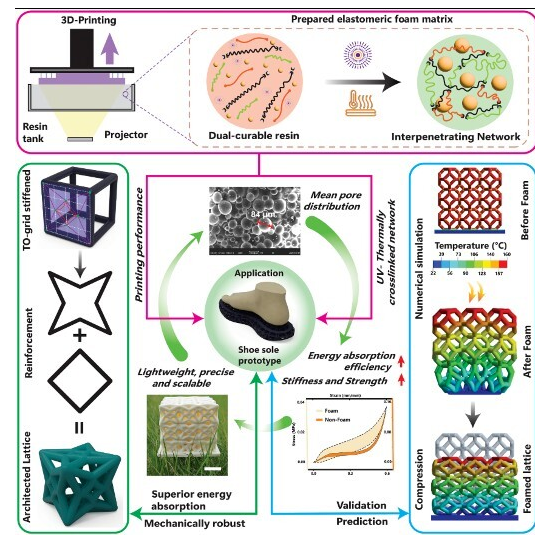
The Secret Is Not Simply Making the Material Harder
Cut open a conventional piece of foam, and you will find countless tiny pores.
These pores reduce its weight while allowing it to compress and deform under pressure.
However, more pores do not automatically produce better performance.
Some structures collapse too easily. Others provide adequate support but become too stiff for comfortable use.
The researchers approached the problem by modifying both the material and its internal geometry.
They began with a three-dimensional lattice structure.
Imagine a network of tiny interconnected struts forming a complex internal framework.
The way those struts connect, the points at which they bend under pressure, and the paths through which forces travel all influence how the structure behaves.
Even small changes in geometry can produce noticeably different mechanical responses.
But the lattice itself was only part of the design.
Instead of using an ordinary solid polymer, the researchers developed a polyurethane-based photocurable resin containing thermally expandable microspheres.
Manufacturing involved two main stages.
First, a light-based 3D printing process was used to fabricate the complex lattice geometry. Selected regions of the liquid resin were cured by light, gradually forming the designed structure.
Next came thermal treatment.
When heated, the expandable microspheres increased in volume, creating additional microscopic pores inside the printed struts.
The result was a structure operating at two different scales.
At the larger scale, a visible three-dimensional lattice distributed loads through its interconnected framework.
At the smaller scale, tiny foam cells were embedded within the struts themselves.
Think of it as a carefully engineered scaffold in which the overall arrangement determines how forces move through the structure, while the internal composition of each supporting element influences how it deforms.
This was no longer just a piece of soft polymer.
It was an engineered combination of material formulation, lattice geometry, and internal foam architecture.
Softness and Strength Do Not Have to Be Opposites
Anyone who has spent time choosing shoes knows the problem.
A sole that is too hard may feel uncomfortable after prolonged walking.
A sole that is excessively soft may compress too much, leaving the foot without adequate support.
It can seem as though manufacturers must choose between cushioning and stability.
Materials engineering offers a more complicated answer.
A well-designed structure can deform under pressure while distributing loads through its internal framework.
The objective is not necessarily to eliminate deformation, but to control it.
Energy management is another important consideration.
When we walk, run, or jump, our shoes experience much more than our static body weight.
Each landing creates a dynamic load.
The sole must deform, manage some of the impact energy, and recover after the load is removed.
By adjusting the foam formulation and lattice geometry, the researchers were able to modify stiffness, mechanical strength, and energy absorption behavior.
In a specific comparison conducted during the study, an optimized foamed lattice achieved an energy absorption efficiency of approximately 48%, outperforming the unfoamed elastomeric structure used for comparison.
There is an important distinction here.
Higher energy absorption efficiency does not necessarily mean greater energy return.
It also does not demonstrate that a shoe made from this material would automatically help someone run faster.
Cushioning, rebound, structural support, and energy dissipation are related, but they are not interchangeable properties.
What the experiment illustrates is something more fundamental:
A material's mechanical behavior depends not only on its chemical composition or inherent softness, but also on how its internal structure is designed.
From a 5-Kilogram Weight to a Real Shoe Sole
Before discussing the footwear experiments, it is important to distinguish two separate tests.
The structure that supported the 5-kilogram weight was a small, 17-gram lattice specimen.
That experiment demonstrated the load-supporting potential of the engineered foam architecture.
The subsequent shoe sole experiments involved different specimens, geometries, and loading conditions.
The results cannot be directly converted from one test to the other.
That distinction matters because the researchers were interested in more than simply producing an impressive load-to-weight ratio.
They wanted to investigate whether the same design approach could be applied to an everyday product.
To explore this possibility, the team fabricated two different 3D-printed shoe sole designs.
Design One: Different Lattice Structures for Different Foot Regions
The first design used different lattice architectures in the forefoot and heel regions.
The reasoning was practical.
During walking, different areas of the foot experience different loading conditions.
The forefoot needs to accommodate bending and movement, while the heel must provide sufficient support during loading.
By changing the lattice design between these regions, the researchers aimed to balance flexibility and structural support.
Under lower loading conditions, this approach demonstrated a useful combination of compliance and support.
However, when the simulated loading conditions increased to those associated with a 120-kilogram body weight, the forefoot region showed insufficient stiffness and supporting capacity.
The more specialized design had revealed a weakness.
Design Two: A More Uniform Lattice Structure
The second shoe sole used a relatively consistent lattice architecture throughout its structure.
Rather than assigning different geometries to different regions, the objective was to achieve a more uniform mechanical response.
This design maintained better structural stability under the study's simulated loading conditions, including an 80-kilogram scenario and a higher total-load scenario equivalent to approximately 130 kilograms.
The latter represented an 80-kilogram person carrying an additional 50-kilogram load.
The comparison produced an interesting finding.
The design that appeared more sophisticated because of its regional customization was not necessarily the most robust under higher loads.
Meanwhile, the more uniform structure performed better in those particular tests.
This does not mean that regionally optimized shoe soles are fundamentally flawed.
Instead, it demonstrates that every region of a customized lattice must be designed and validated against its intended loading conditions.
Changing the internal geometry can significantly alter performance, even when the underlying materials and manufacturing methods are similar.
The study also included laboratory cyclic-bending evaluation, but such testing does not establish every aspect of long-term performance under real-world wearing conditions.
A structure that survives a particular laboratory test has not automatically demonstrated satisfactory abrasion resistance, wet-surface traction, environmental durability, or long-term comfort.
Similarly, the fact that a 17-gram lattice specimen supported a 5-kilogram weight does not mean that an entire shoe can safely carry 294 times its own weight.
And mechanical load-bearing capacity alone does not establish whether a shoe will actually feel comfortable.
The Next Generation of Shoes May Be Designed from the Inside Out
The most interesting part of this research may not be the number 294.
It may be the manufacturing concept behind it.
Traditionally, footwear manufacturers have adjusted sole performance by changing foam formulations, material hardness, thickness, or combinations of different materials.
These approaches remain important and widely used.
But 3D-printed lattices introduce another design variable:
The internal three-dimensional architecture of the sole itself.
In principle, engineers can use the same class of material while modifying pore size, strut thickness, cell geometry, and local lattice density to produce different mechanical responses.
One region might be designed for greater flexibility.
Another might prioritize load support.
A third might reduce material consumption while maintaining the required structural properties.
Instead of relying exclusively on adding or removing layers of foam, engineers can design how individual regions respond to pressure.
This creates interesting possibilities for footwear development, particularly in applications where cushioning, flexibility, weight, and mechanical support must be balanced.
It also changes the role of 3D printing.
The technology is no longer limited to producing geometries that are difficult to manufacture using conventional methods.
It can be used to engineer the functional behavior of a component through its geometry.
However, moving from a laboratory prototype to a commercial shoe presents significant challenges.
Long-term fatigue resistance, abrasion resistance, traction, production consistency, manufacturing cost, and throughput all require further evaluation.
These considerations are especially important when working with photocurable elastomers.
The final mechanical properties of a printed elastomeric component depend on multiple factors, including resin formulation, printing parameters, cleaning procedures, and post-curing conditions.
A successful experiment using one carefully developed formulation does not mean that any flexible 3D printing resin will produce equivalent results.
Material selection and structural design must be considered together.
For footwear manufacturers, this may eventually create new opportunities in functional prototyping, customized midsole development, and small-batch production.
But the potential advantages still need to be demonstrated through application-specific testing.
A 17-Gram Structure Could Change How We Think About Shoe Soles
Return to the experiment that started this story.
A lightweight, 17-gram lattice structure supported a 5-kilogram weight.
That is an impressive demonstration.
Yet the more important lesson is that we may have underestimated the influence of internal geometry on material performance.
A flexible polymer can be printed as a solid component.
It can also be arranged into an open lattice.
And the individual struts of that lattice can themselves contain microscopic foam cells.
Each design can produce a different response to loading, deformation, and impact.
The material may belong to the same general category, but its functional behavior can change substantially.
This is one of the directions in which additive manufacturing is evolving.
The question is shifting from:
Can we 3D print this complicated shape?
To something much more demanding:
Can we design and manufacture a complex internal structure that delivers a specific mechanical function?
For footwear designers, flexible material developers, and industrial 3D printing engineers, the second question may be far more consequential.
So the next time you pick up a pair of shoes and press your thumb into the sole, consider asking a different question.
Is its softness primarily the result of the material formulation, or has it been engineered into the structure?
The shoe soles of the future may not necessarily be thicker or softer. Their internal geometry may simply be designed with far greater precision.