
Small-Batch 3D Printing: How to Control Cost and Quality
Small-batch 3D printing can reduce tooling commitments and make limited production runs more flexible. However, the cost of printing a part is not the same as the cost of delivering a part that passes inspection.
Quick answer: To control cost and quality in small-batch resin 3D printing, calculate the total cost per accepted part, validate a representative production batch, standardize printing and post-processing parameters, and inspect critical features against written acceptance criteria. A lower material cost or faster print cycle does not necessarily result in a more economical production process.
For factories, engineering teams, and production managers, the objective is to balance manufacturing cost, dimensional requirements, surface quality, material suitability, and repeatable output.
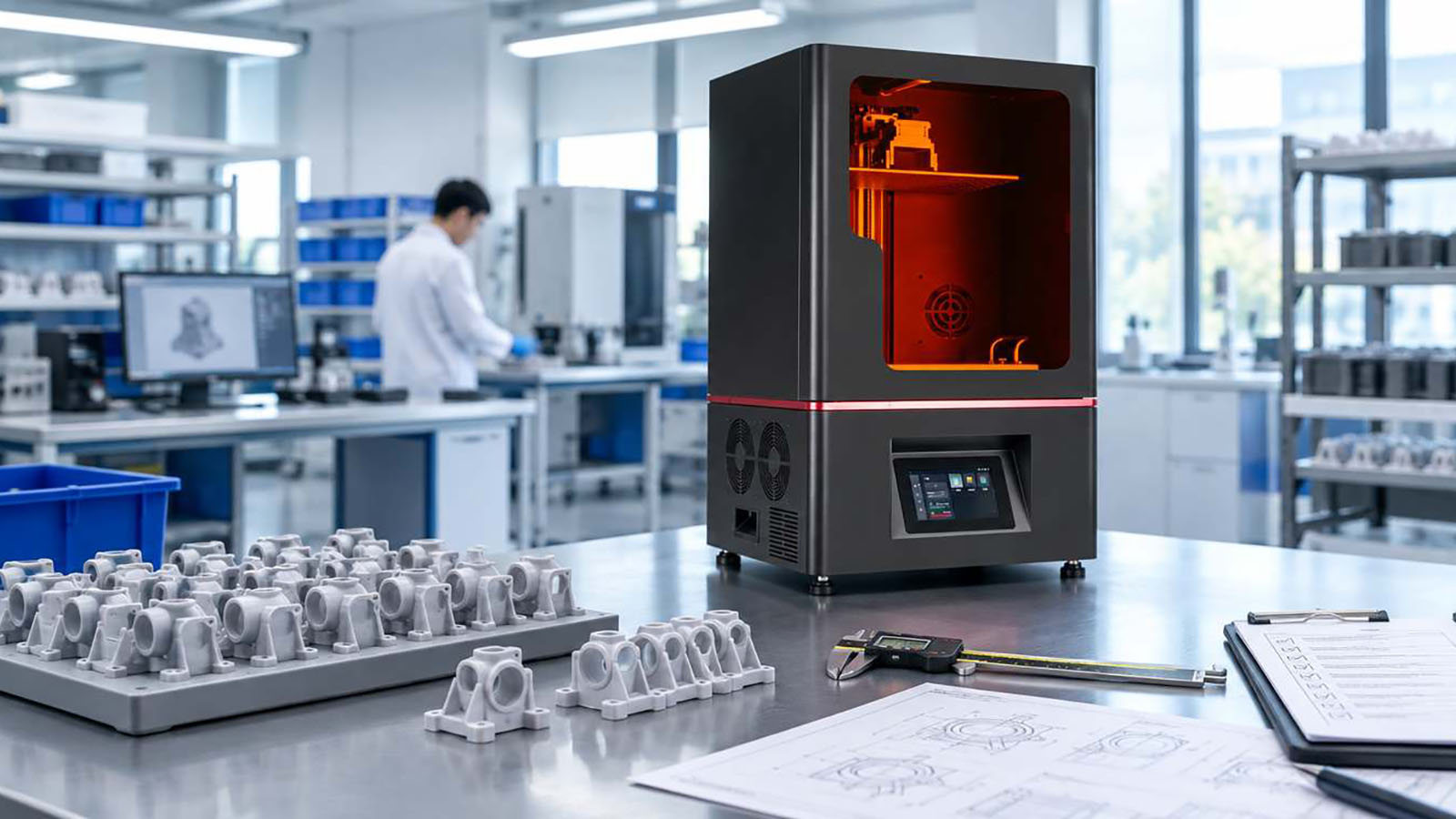
1. What Determines Small-Batch 3D Printing Cost?
Small-batch production occupies the space between individual prototyping and large-scale manufacturing. Parts may be produced in limited quantities, revised frequently, or customized for different applications.
Resin 3D printing can be attractive because production is driven by digital files rather than dedicated injection molds. Nevertheless, each batch still consumes materials, equipment capacity, labor, and inspection resources.
The relevant cost categories include:
| Cost Component | What It Includes | Potential Cost Driver |
|---|---|---|
| Production preparation | File review, orientation, supports, slicing, setup, and initial validation | Complex geometry or frequent design changes |
| Resin and consumables | Part resin, supports, process losses, cleaning consumables, and replacement items | Material selection, support volume, and waste |
| Machine allocation | Allocated equipment ownership, maintenance, and operating costs | Utilization and productive machine time |
| Labor | Setup, unloading, cleaning, support removal, finishing, and handling | Manual work required per batch |
| Post-processing | Washing, drying, UV post-curing, and associated equipment operation | Part geometry and validated processing requirements |
| Quality control | Measurement preparation, inspection, documentation, and review | Critical dimensions and acceptance requirements |
| Nonconforming output | Rejected builds, reprinting, permitted rework, and related recovery activities | Process instability and acceptance losses |
These costs should be evaluated at the complete workflow level rather than treating resin consumption as the final unit price.
For a more detailed breakdown of machine, material, and production expenses, see Yidimu's industrial resin 3D printing cost-per-part guide.
2. Calculate Cost Per Accepted Part, Not Just Cost Per Print
The number of parts produced during printing is not necessarily the number that can be delivered to a customer or used in production.
Some parts may be rejected because of dimensional deviation, surface damage, incomplete features, distortion, or an unsuccessful post-processing step.
A meaningful comparison therefore requires two records: the total cost incurred during production and the quantity that passes inspection after the required workflow is complete.
Why does acceptance rate matter?
When a batch loses parts to rejection, its production cost is distributed across fewer usable components. Reprinting also consumes machine capacity and can delay delivery.
Two build layouts may have similar resin consumption but different accepted-part costs. The layout with more parts does not automatically provide better economics if support removal is difficult or dimensional consistency deteriorates.
The economically useful output is the quantity of acceptable finished parts, not the number of objects initially placed on the build platform.
3. Quality Control Begins Before Printing
Quality control should not be limited to checking finished parts. In small-batch resin printing, many defects can be prevented by controlling the production file, material, machine setup, and processing workflow.
Define Requirements
Identify critical dimensions, fit surfaces, appearance requirements, intended service conditions, and acceptance limits before production.
Validate the Process
Test representative geometry with the intended resin, build orientation, support layout, washing procedure, and curing cycle.
Lock Approved Settings
Record the model revision, printer configuration, resin identification, slicing profile, supports, and post-processing instructions.
A successful prototype is useful for feasibility testing, but it does not establish that the process can repeatedly produce an acceptable production batch.
Before production release, evaluate a representative build at the intended layout density. Inspect parts from different platform positions where positional variation could affect the result.
4. Build a Practical Inspection Plan
Inspection requirements should reflect the intended use of the part. A decorative model and an assembly component may require very different acceptance methods.
Rather than measuring every feature without a clear purpose, identify the characteristics that determine whether the part can perform its intended function.
| Quality Characteristic | Suggested Inspection | Acceptance Basis |
|---|---|---|
| Critical dimensions | Suitable calibrated dimensional measurement equipment | Drawing tolerances and agreed measurement conditions |
| Assembly fit | Mating-part or approved functional gauge check | Defined assembly requirement |
| Surface appearance | Visual inspection under defined conditions | Agreed cosmetic criteria |
| Support-contact areas | Visual or tactile evaluation as appropriate | Permitted marks and surface requirements |
| Warping and distortion | Flatness, profile, or assembly-related checks | Specified geometric requirements |
| Material performance | Application-appropriate functional or laboratory testing | Documented performance requirements |
| Batch consistency | Measurements across selected positions and repeated builds | Approved process and sampling plan |
Final dimensions should be evaluated after the specified cleaning, drying, and post-curing sequence, at defined measurement conditions where necessary.
Sampling is appropriate only where the application risk and quality plan permit it. Safety-critical or regulated parts may require additional testing, traceability, and formal qualification.
5. How to Reduce Cost Without Sacrificing Quality
Improve build layout carefully
Printing several components in one build can distribute setup and machine time across more parts. However, platform density must be balanced against separation forces, drainage, supports, cleaning access, and inspection requirements.
Compare layouts using the complete accepted-part cost. A less densely packed build may be preferable if it reduces rework or improves repeatability.
Reduce avoidable support-related work
Support placement affects resin consumption, handling time, and surface condition. Review whether supports can be placed away from critical fit features and cosmetic surfaces.
Do not reduce support density simply to save material if doing so makes printing unreliable. Changes should be validated against the real component.
Standardize washing and post-curing
Washing, complete drying, and UV post-curing influence finished-part consistency. Use the applicable material instructions and validated process settings rather than assuming one cleaning or curing schedule works for every resin.
Maintain suitable processing records and monitor cleaning-media condition. A poorly controlled post-processing stage can create variation even when printing itself appears consistent.
Reduce reprints through process records
Repeated jobs should use a documented process baseline. If a part fails, the production team should be able to identify the file revision, resin, machine setup, platform position, and processing conditions associated with the failure.
This information supports root-cause analysis instead of repeatedly changing parameters without knowing which variable caused the defect.
6. A Batch-Level Cost and Quality Control Worksheet
The following worksheet is a practical starting point for a production trial. Complete it using measurements and costs from the actual manufacturing process.
| Record | Data to Capture | Purpose |
|---|---|---|
| Part and process ID | Drawing revision, machine, resin grade and lot, approved process revision | Traceability |
| Build information | Build ID, date, operator, platform layout and settings | Process consistency |
| Production quantity | Planned, printed, rejected, reworked and accepted quantities | Acceptance-rate assessment |
| Material usage | Part resin, supports and recorded process losses | Material costing |
| Machine and labor | Machine hours, allocation method, hands-on time | Operating cost |
| Post-processing | Wash, drying, curing, finishing time and relevant consumables | Workflow costing |
| Inspection results | Critical dimensions, surface condition, fit checks and disposition | Quality verification |
| Final economics | Total defined cost divided by accepted quantity | Cost per accepted part |
This worksheet also helps reveal why a batch becomes expensive. The cause may be resin consumption, excessive support removal, unstable curing results, inspection workload, or repeated failures.
Keep one consistent accounting basis when comparing production options. Otherwise, one process may appear cheaper simply because its inspection or recovery costs were omitted.
7. When Should Production Stop for Investigation?
Not every defect requires a complete process redesign. However, continuing production without investigating recurring or critical failures can increase scrap and create larger quality problems.
A production hold should be considered when:
A critical dimension repeatedly falls outside the approved tolerance.
Parts from a particular platform region show recurring deviations.
Unexpected deformation appears after washing or post-curing.
Layer separation, incomplete curing, or adhesion failures recur.
A resin lot or process change produces unexplained differences.
Inspection equipment or measurement conditions are unreliable.
Segregate affected output and investigate the relevant cause before releasing further parts. Review the model, resin condition, supports, equipment, process settings, and post-processing records as appropriate.
Engineering decision: If repeated defects persist under an approved process, avoid compensating through uncontrolled exposure or curing changes. Establish whether the problem originates from geometry, material, printing equipment, or post-processing, then validate the corrective action.
8. Compare 3D Printing With Conventional Manufacturing
Small-batch resin 3D printing is not automatically the lowest-cost manufacturing route. The practical choice depends on quantity, design stability, required material properties, tooling commitment, and finished-part acceptance requirements.
| Decision Factor | Resin 3D Printing | Conventional Process |
|---|---|---|
| Initial tooling | Often avoids dedicated production molds | Tooling may be required depending on the process |
| Design changes | Digital revisions can be implemented and revalidated | Changes may require machining or tooling adjustments |
| Material selection | Limited to compatible and validated photopolymer systems | May offer broader engineering material options |
| Production volume | Potentially useful for limited or variable demand | Often attractive for stable, larger production quantities |
| Quality control | Requires control of printing, washing, curing, and inspection | Requires process-specific controls and validation |
| Unit cost | Depends on accepted output and workflow efficiency | Depends on tooling allocation, process cost, volume, and yield |
For process selection, compare alternatives against the same drawing, production quantity, material requirements, delivery conditions, and quality acceptance criteria.
Research from the National Institute of Standards and Technology (NIST) has examined situations where additive manufacturing can be economically attractive for small production quantities, while also identifying circumstances in which conventional manufacturing remains more cost-effective.
9. Evaluating a Yidimu Resin Printing Workflow
Yidimu provides industrial resin 3D printing equipment and related materials, cleaning and UV-curing solutions for professional applications.
For example, the Eternal M2 is an industrial resin printer intended for engineering models, larger components, and multi-part printing applications. Flexible resin production may require a different equipment and material workflow, such as an application-specific evaluation involving the Flex G2.
The appropriate system cannot be selected from machine specifications alone. The intended resin, supported-part dimensions, batch layout, post-processing capacity, and acceptance criteria should all be assessed together.
Production teams can review the Yidimu 3D printer range and the small-batch resin printer selection guide before arranging representative sample evaluation.
10. Frequently Asked Questions
Is 3D printing cheaper for small-batch production?
It can be, particularly when dedicated tooling would be difficult to justify or designs are likely to change. The actual comparison must include materials, machine allocation, labor, post-processing, inspection, rejected parts, and the expected production quantity.
What is the most important quality-control metric?
No single metric captures every application. Critical-feature conformity, process repeatability, and acceptance rate are important together. Cost per accepted part connects the quality result with the manufacturing economics.
Can higher build-platform utilization reduce unit cost?
Yes, when the additional parts do not create unacceptable failure risk, support complexity, cleaning difficulties, or inspection problems. Layout changes should be validated using finished and inspected parts.
How often should small-batch resin parts be inspected?
Inspection frequency depends on part criticality, production stability, contractual requirements, and applicable regulations. Establish the plan before production and revise it when a significant process change or quality issue requires additional validation.
Does high printer resolution guarantee consistent production quality?
No. Nominal pixel size or display resolution does not independently establish finished-part dimensional accuracy or repeatability. Resin behavior, exposure conditions, orientation, supports, washing, post-curing, and measurement all affect the final result.
Evaluate Your Small-Batch Production Requirements
Before selecting equipment or committing to a production route, prepare the part geometry, target quantity, material requirements, critical dimensions, surface expectations, and inspection criteria.
Yidimu can discuss suitable resin 3D printing equipment, material options, post-processing requirements, and sample-printing evaluation for your application. Final production capability should be confirmed through representative testing.
Discuss Sample Printing With Yidimu →References
National Institute of Standards and Technology (NIST). Costs and Cost Effectiveness of Additive Manufacturing.
NIST publicationNIST. Six-sigma Quality Management of Additive Manufacturing.
NIST publicationISO/ASTM 52920:2023. Qualification Principles — Requirements for Industrial Additive Manufacturing Processes and Production Sites.
ISO standard overviewISO/ASTM 52902:2023. Test Artefacts — Geometric Capability Assessment of Additive Manufacturing Systems.
ISO standard overview