
Flexible Resin 3D Printing: An Engineer's Guide
Flexible resin 3D printing cures a liquid photopolymer into a rubber-like part, layer by layer, on an LCD, DLP or laser SLA machine. It suits soft parts with fine detail or geometry that can't be molded, such as lattices, cushioning structures, grips and seals for fit checks. The catch is that a Shore hardness number says little about rebound, tear resistance or fatigue, and soft resins print, wash and cure differently from rigid ones.
This guide is based on general photopolymer and rubber-testing practice, with YIDIMU catalogue data where a figure is quoted. It covers vat photopolymerization only. Filament TPU and powder-bed elastomers follow different rules. Datasheet values are measured on standard specimens, not on finished parts.
What "flexible" means on a resin datasheet
There is no standard definition, so read the numbers and ignore the product name. Suppliers use "flexible" and "elastic" loosely. In practice, a flexible grade bends and recovers slowly, while an elastic grade stretches and returns quickly. Two resins with the same hardness can feel completely different in the hand.
Shore A hardness is the figure everyone quotes, and it is the least informative. ASTM D2240 describes durometer hardness as an empirical test meant mainly for control purposes, with no simple relationship to any fundamental material property. It measures resistance to a small indentor on a thick, flat specimen. You can't press a durometer onto a 1 mm lattice strut and get a meaningful reading.
| Property | What it tells you | What it doesn't tell you | Common test method |
|---|---|---|---|
| Shore A hardness | Resistance to surface indentation | Rebound, durability, stiffness of a thin-walled part | ASTM D2240 |
| Elongation at break | How far a specimen stretches once before it fails | Behavior under repeated, smaller strains | ASTM D412 |
| Tear strength | Resistance to a nick or cut growing | Results from different specimen shapes aren't comparable | ASTM D624 |
| Rebound resilience | Share of impact energy returned | Permanent deformation over time | ASTM D2632 |
| Compression set | Permanent deformation after being held compressed | Dynamic fatigue life | ASTM D395 |
| Flex fatigue | Cycles a standard specimen survives | Life of your geometry under your load | Varies by supplier; ask which |
If a datasheet lists hardness and elongation but leaves out rebound, tear and compression set, ask for them before shortlisting the material. For a cushioning part, those three decide whether it works.
Where flexible resin fits, and where another process is the better call
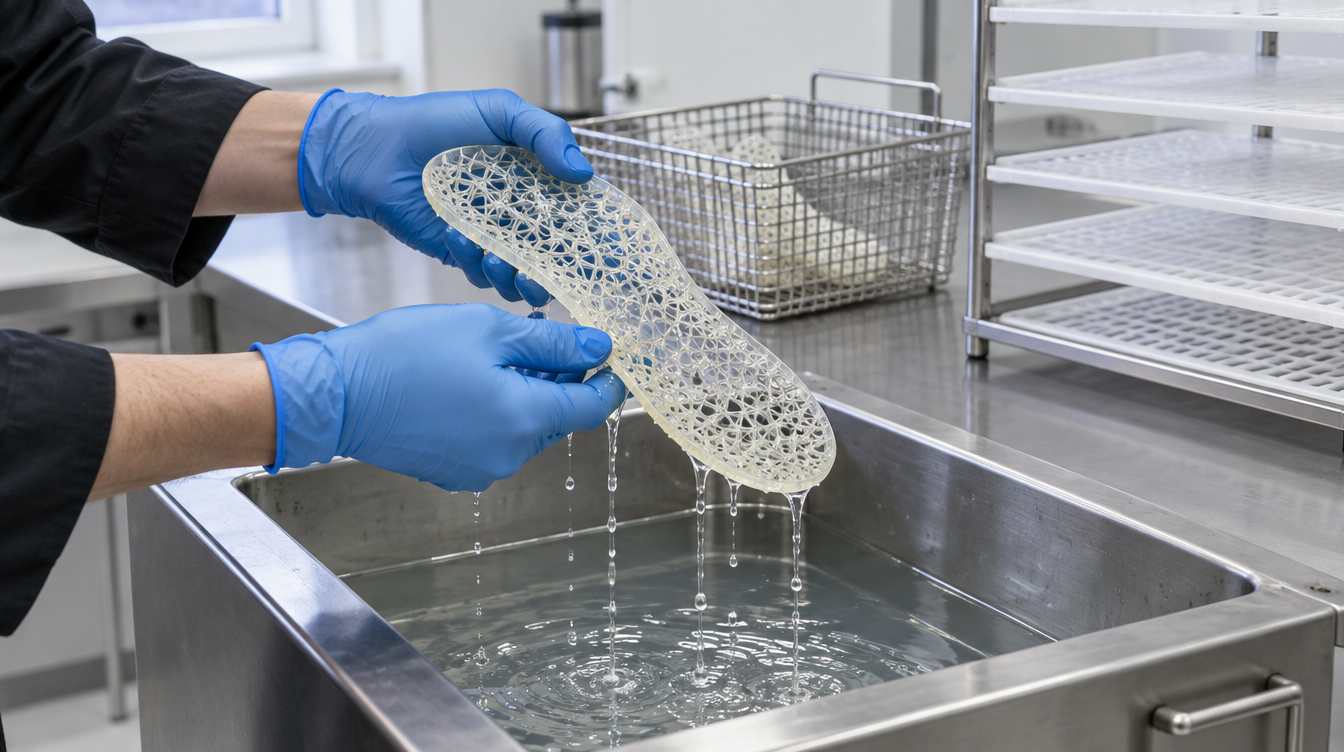
Flexible resin earns its place when the geometry is the point. Lattice midsoles and insoles, saddle and helmet padding, soft robotic grippers, wearable components and soft-touch housings all rely on thin walls, fine struts or internal cells that tooling can't produce. It is also a fast way to check the fit of a gasket or boot before cutting a mold.
It is a weaker choice in a few cases:
Simple shapes at high volume. Molded silicone, rubber or TPU will cost less per part and bring better-documented long-term properties.
Thick solid sections. Large solid blocks use a lot of resin, cure unevenly through the wall and are hard to wash clean.
Heavy abrasion or continuous oil and solvent contact. Powder-bed or molded TPU often holds up better. Test before assuming either way.
Skin-contact or medical use. This needs documented biocompatibility for the specific resin and process, not a general claim.
How soft resin behaves differently in the printer
Three things change compared with rigid resin: viscosity, green strength and supports.
Viscosity and temperature
Elastomer resins are thick. YIDIMU's catalogue lists its elastomeric resin at 2,500–3,000 cps at 25 °C, while its rigid, model and dental grades sit in the low hundreds. Thick resin flows back under the platform slowly and holds bubbles longer. Viscosity also shifts quickly with temperature, so a cold shop in the morning and a warm one in the afternoon can give two different results from the same file. This is why elastomer-focused machines control resin or chamber temperature.
Green strength and peel
A freshly exposed layer of soft resin is weak and stretchy. During peel it tends to stretch instead of releasing cleanly, so thin walls come out wavy and fine struts shift. Slower lift speeds, a low release-force film and longer settling time before exposure all help. Each of them costs build time, which matters when you plan throughput.
Supports and orientation
Soft parts sag, so they need more support than a rigid part of the same shape. Every support tip leaves a nub, and on an elastomer a nub is a place for a tear to start. Design lattices to be self-supporting where you can, and orient the part so supports land on faces that don't flex in use.
Exposure deserves the same care. Over-exposure closes small lattice cells and stiffens the part. Under-exposure leaves weak bonding between layers. Uneven light across the platform shows up as parts that feel different depending on where they were printed, which is why light uniformity matters more for elastomers than for display models.
Washing and post-curing change the material
With flexible resin, post-processing sets the final properties. It isn't a cleanup step.
Solvents swell uncured and partly cured elastomer. A long soak leaves the part oversized and soft until the solvent evaporates, and curing it in that state locks in stress. Keep washes short, use clean solvent and let parts dry fully before they go under UV. Lattices trap liquid resin inside their cells. Compress the part gently in the bath to pump solvent through, or it will weep and stay tacky for days.
Post-cure dose moves hardness. More UV energy and heat generally raise hardness and lower elongation, so the same resin can land at different points depending on time, temperature and distance from the lamps. Fix one recipe and record it. Cure the part in its relaxed shape too. A part cured while bent or squashed keeps some of that shape.
How to validate a flexible printed part
Test the part itself, made with the final process. A datasheet can't stand in for that. This sequence works for most soft parts:
Write down the load case. Compression, bending or stretch, how far, how many cycles and at what temperature.
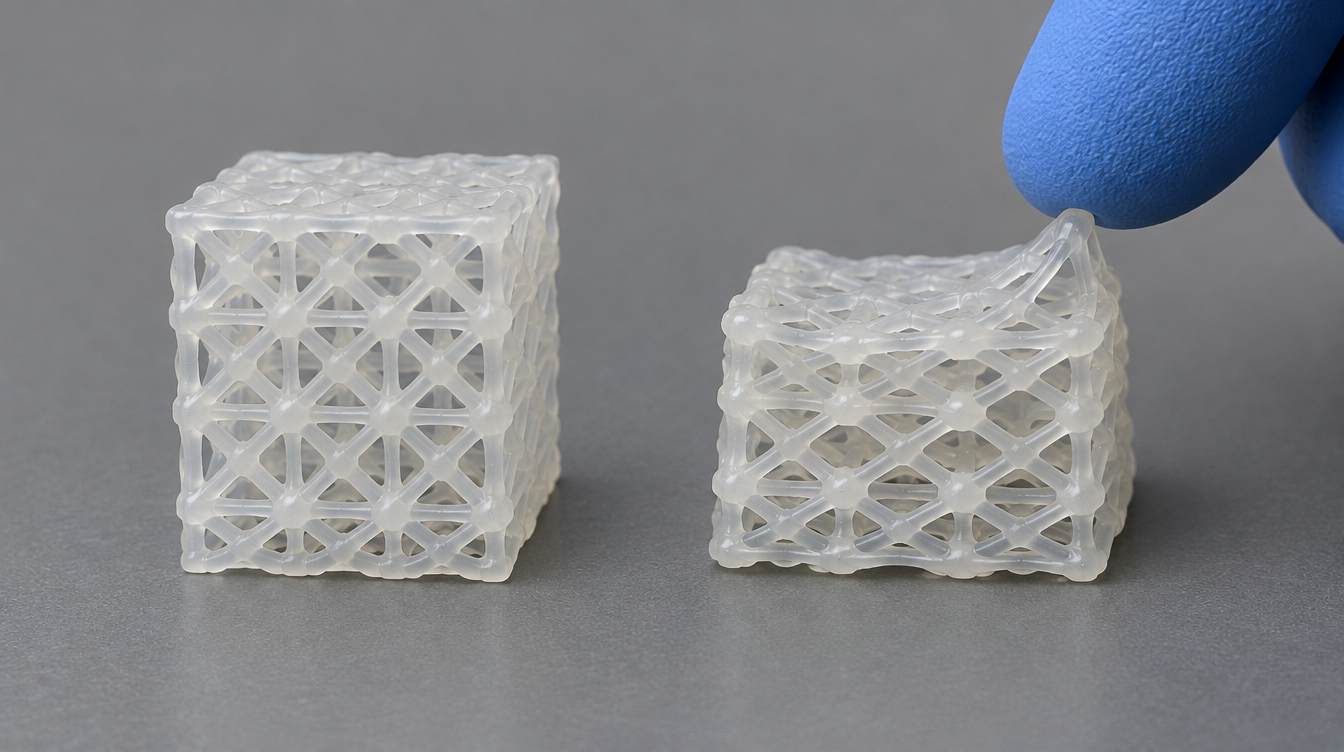
Print the real geometry. Place copies at several platform positions. Test coupons alone won't show how a lattice behaves.
Freeze the wash and post-cure recipe before you measure anything.
Measure consistently. Let parts rest for the same period after curing. Calipers squeeze soft parts, so use a go/no-go fixture or optical measurement in the free state.
Test function. Record a force-displacement curve on the part, cycle it, then check for permanent set and for tears at support nubs and lattice nodes.
Repeat across builds. One good part proves little. The same checks apply as in any low-volume resin production process.
One limit to plan for: photopolymer elastomers can stiffen or discolor with light exposure and age. How much depends on the formulation and the environment, so there is no universal figure. If the part must last, run an aging test on it.
Equipment built for elastomer resin
A general-purpose resin printer can run some flexible grades, but thick, soft resins are easier to control on a machine designed around them. YIDIMU's Flex G2 is an LCD masked-exposure system dedicated to elastomers, with a 302 × 162 × 370 mm build volume. For larger parts, the Flex Pro offers a 450 × 253 mm build area with automatic chamber temperature control. Both are catalogued for elastomer resins from 50A to 90A.
Those are specifications, not part results. Whichever supplier you consider, evaluate the manufacturer on how it handles your geometry and your test plan.
Next step
Send a representative CAD file and your load case to the YIDIMU application team. We'll print it in elastomer resin and return the parts with the wash and post-cure settings used, so you can run your own tests on the real geometry.