
Can 3D Printing Change Marine Propeller Manufacturing? A Real WAAM Case Study
A 3D printed marine propeller can take longer to machine than to print and still reach the customer faster than a conventionally cast replacement. A project in Dubai illustrates why: producing a 26 kg stainless steel propeller required about 20 hours of metal printing and 100 hours of machining, yet the project reportedly reduced total lead time by approximately 60% and manufacturing cost by 40% compared with the casting route considered for that order.
The advantage did not come from eliminating finishing work. It came largely from avoiding new casting tooling and the associated foundry wait.
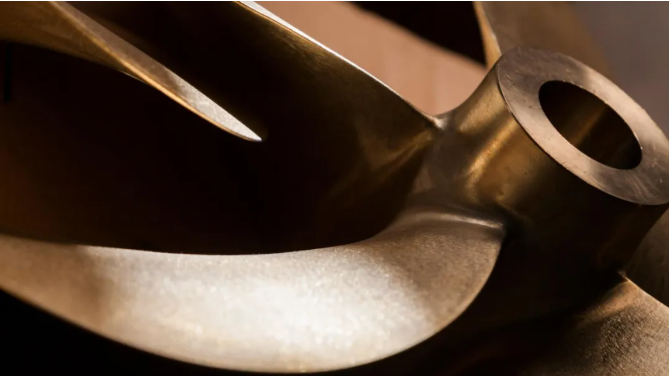
Figures reported for the JOME Engineering project. Lead-time and cost improvements refer to this specific comparison with a conventional casting approach. They are not universal WAAM performance claims. Printing and machining hours alone do not represent the complete order lead time.
A Marine Propeller With No CAD Drawings
JOME Engineering, a marine engineering company based in Dubai, needed to reproduce an existing ship propeller for a customer. The replacement had to be delivered quickly, but there was no usable CAD file or existing tooling.
The original propeller itself was the only source of geometric information. Its blade curvature, pitch and transition into the central hub all had to be captured before manufacturing could begin.
A conventional casting route would have required new tooling and foundry scheduling. For a one-off replacement, these steps could introduce substantial cost and waiting time before a usable casting became available.
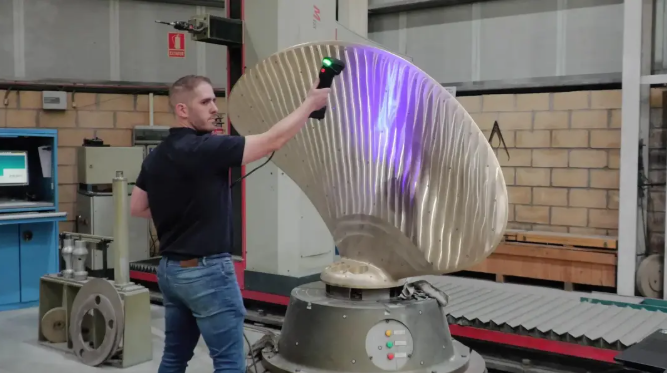
Instead, the engineering team used 3D scanning to capture the original geometry, reconstructed a digital model and manufactured the replacement through robotic metal additive manufacturing.
Project specifications
Component: Three-blade marine propeller
Material: 316L stainless steel
Final diameter: 685 mm
Final weight: 26 kg
Manufacturing technology: Wire Arc Additive Manufacturing (WAAM)
What Is WAAM, and Why Does It Require Machining?
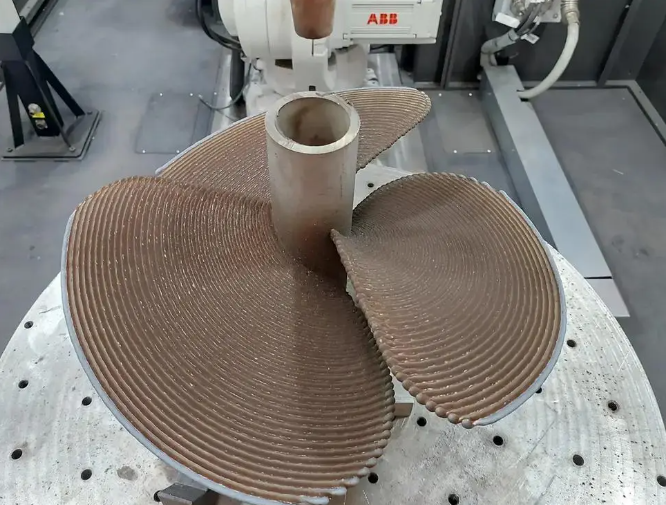
Wire Arc Additive Manufacturing, or WAAM, is a metal 3D printing process that uses an electric arc to melt metal wire and deposit material along a controlled toolpath.
A robotic system builds the component progressively, creating a near-net-shape metal part without requiring the same type of dedicated tooling used in conventional casting.
WAAM can be particularly useful for larger metal components. However, the deposited material typically shows visible weld-bead patterns, and extra material may be required to allow subsequent machining to achieve final dimensions.
A marine propeller is a demanding example. Its complex blade geometry must be finished and checked before the component can meet its intended requirements.
In this application, additive manufacturing produced the metal geometry, while conventional machining helped bring it to the required final condition.
How the 3D Printed Propeller Was Manufactured
The project used a staged manufacturing approach rather than attempting to print the entire component in one uninterrupted operation.
3D scanning and reverse engineering.The original propeller was scanned to recover its geometry and establish the digital reference for manufacturing.
Central hub fabrication.The central hub, or boss, was printed first and then precision-machined.
Inspection before blade deposition.The machined hub underwent dye penetrant inspection to check for relevant surface defects before the next manufacturing stage.
Printing the three blades.Following inspection, the three propeller blades were built onto the hub using the WAAM process.
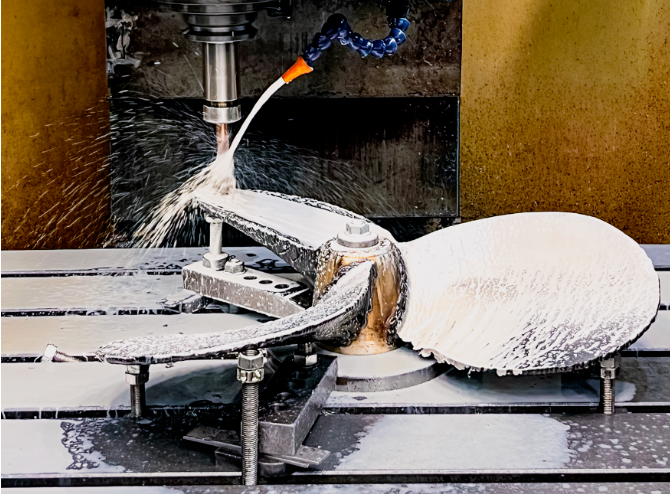
Progressive machining and scanning.The team repeatedly scanned the part during machining to compare its evolving geometry with the digital reference and verify remaining machining allowance.
Final finishing and verification.The work concluded with manual grinding, pitch verification and balancing.
The reported metal printing time was approximately 20 hours. Machining required roughly 100 hours, making it the more time-intensive operation.
Why Did Machining Take Five Times Longer Than Printing?
A propeller blade is a twisted freeform surface rather than a simple flat or cylindrical feature. Its geometry varies continuously across the blade, making toolpath planning and part alignment more difficult.
WAAM also produces a near-net-shape blank, not a uniformly finished component with convenient reference surfaces.
That creates several practical machining challenges:
Establishing reliable positioning and alignment for the irregular blank.
Determining how much material can safely be removed from each blade region.
Maintaining the intended blade geometry throughout multiple machining operations.
Checking whether enough material remains for subsequent finishing.
The JOME team addressed these risks by repeatedly scanning the component during machining. Each scan provided an opportunity to compare the current part with its target geometry and review the remaining stock.
This inspection-led approach helps explain why machining occupied so much of the manufacturing effort.
Important distinction: The reported 100 hours refers to machining. It should not be interpreted as the total duration of every post-processing and inspection activity. Similarly, adding 20 and 100 hours does not establish the complete lead time from customer order to delivery.
Why Was 3D Printing Still Faster Than Casting?
The answer lies in the difference between machine operating time and total order lead time.
A cast marine propeller may also require machining, surface finishing, dimensional inspection and balancing. These activities are not exclusive to additive manufacturing.
For this order, the major opportunity was upstream of machining.
Because a digital model could be used to produce the metal blank directly, the team avoided preparing dedicated casting tooling and waiting for a foundry production slot.
According to the project report, this manufacturing route delivered:
Approximately 60% shorter lead time than the casting approach considered for the replacement order.
Approximately 40% lower manufacturing cost under the same project comparison.
These improvements should not be generalized to every marine propeller or every WAAM application.
If hundreds of identical components are required, the initial casting tooling cost can be distributed across a larger production quantity, potentially making casting more economical.
For a single urgently needed component with no existing tooling, the economics can be very different.
Metal 3D Printing vs. Casting: Which Makes More Sense?
| Evaluation Factor | Metal Additive Manufacturing | Conventional Casting |
|---|---|---|
| One-off replacement parts | May avoid dedicated tooling and reduce preparation time. | New tooling may introduce additional cost and lead time. |
| Repeated production | Requires evaluation of machine time, material and machining costs. | Tooling investment can be distributed across production volume. |
| Complex geometries | Can produce complex near-net-shape blanks, but finishing may remain necessary. | Feasibility depends on mold design, casting process and inspection requirements. |
| Machining requirements | Depends on dimensional tolerance, surface finish and functional requirements. | May require similar machining and finishing operations. |
| Total lead time | Includes scanning, modeling, planning, printing, finishing and inspection. | Includes tooling, scheduling, casting, finishing and inspection. |
Neither process is automatically superior. The appropriate manufacturing route depends on quantity, geometry, material, quality requirements, available equipment and the delivery schedule.
How Engineers Should Measure Real Manufacturing Efficiency
This case offers a practical lesson for engineering teams and purchasing departments: comparing production methods by machine speed alone can lead to the wrong decision.
A more useful evaluation follows the complete order, from receiving the customer's requirements to having an accepted component ready for delivery.
Five stages to include in a lead-time comparison
Engineering preparation:CAD preparation, 3D scanning, reverse engineering, process planning and programming.
Tooling and scheduling:Mold or fixture preparation, material procurement, machine availability and outside processing queues.
Primary manufacturing:Additive deposition, casting or another main forming operation.
Post-processing:Machining, support removal, cleaning, finishing and other required downstream operations.
Verification and release:Dimensional inspection, defect detection, required functional checks and delivery preparation.
A practical comparison method
Evaluate competing manufacturing methods using the same part drawing, quantity, material requirements and acceptance criteria. Record total calendar lead time, relevant processing costs, inspection requirements and the number of accepted parts delivered.
Faster delivery does not eliminate the need for appropriate material qualification and component verification, especially in safety-critical applications.
What Can Resin 3D Printing Learn From This Example?
WAAM and vat photopolymerization technologies such as LCD, SLA and DLP are fundamentally different processes.
A resin-printed prototype generally does not require the extensive metal machining seen in this marine propeller project. However, resin printing has its own downstream operations that influence total production capacity.
Depending on the material and application, a typical workflow may include part removal, uncured resin washing, drying, support removal, UV post-curing, surface finishing and dimensional inspection.
For example, an industrial prototype may require critical-hole measurements and fit checks. A dental model may require dimensional stability and clear reproduction of its intended geometry. Flexible lattice structures may need careful cleaning and validation of final behavior after curing.
The same manufacturing principle applies: a printer's maximum printing speed is not the same as the throughput of the entire production system.
Engineers planning regular production should consider the relationship between printer capacity, washing equipment, curing capacity, operator workload and inspection.
For a more detailed selection framework, see Yidimu'sguide to choosing a resin 3D printer for small-batch production. Material compatibility and curing requirements can also be reviewed in the3D printing resin materials overview.
Will 3D Printing Disrupt Marine Propeller Manufacturing?
One successful marine propeller project does not establish that metal 3D printing will replace conventional casting throughout the shipbuilding industry.
What it does demonstrate is a different way to manage a specific manufacturing problem: reproducing a complex replacement component without original CAD files or existing tooling.
Combining 3D scanning, reverse engineering, metal additive manufacturing and precision machining can provide an alternative route for suitable spare-part orders.
The digital model also remains available for future production. If the same geometry is required again, the engineering team can reuse that reference rather than starting with a new scan of the physical part.
The value of additive manufacturing is therefore not limited to how quickly material can be deposited. It also depends on the preparation, tooling, scheduling and downstream work that the chosen production method requires.
The more meaningful manufacturing metric is not simply how many hours a machine prints. It is how quickly a supplier can deliver a component that meets the agreed requirements.
References
Caracol — JOME Engineering Builds 3D Printed UAE's First Marine Propeller.Original project case study
VoxelMatters — JOME 3D Prints UAE's First Marine Propeller Using Vipra AM.Industry coverage, October 15, 2026