
Can Dental Model Resin Be Used in the Mouth?
No, if the resin is intended only for dental models. Use it for the laboratory applications listed by its manufacturer. Do not use it for an intraoral try-in, night guard, surgical guide or restoration unless the exact material's current instructions for use explicitly cover that application.
Extra washing, longer UV curing, polishing or disinfection does not establish a new clinical indication. A patient-contact part needs an appropriate material, a supported manufacturing process and the documentation required in the market where it will be used.
Dental models and intraoral devices have different jobs
A dental model reproduces teeth and surrounding anatomy for work outside the mouth. An intraoral device is placed in the patient's mouth for a defined clinical purpose. Both can be made in a dental laboratory, but they require different material decisions.
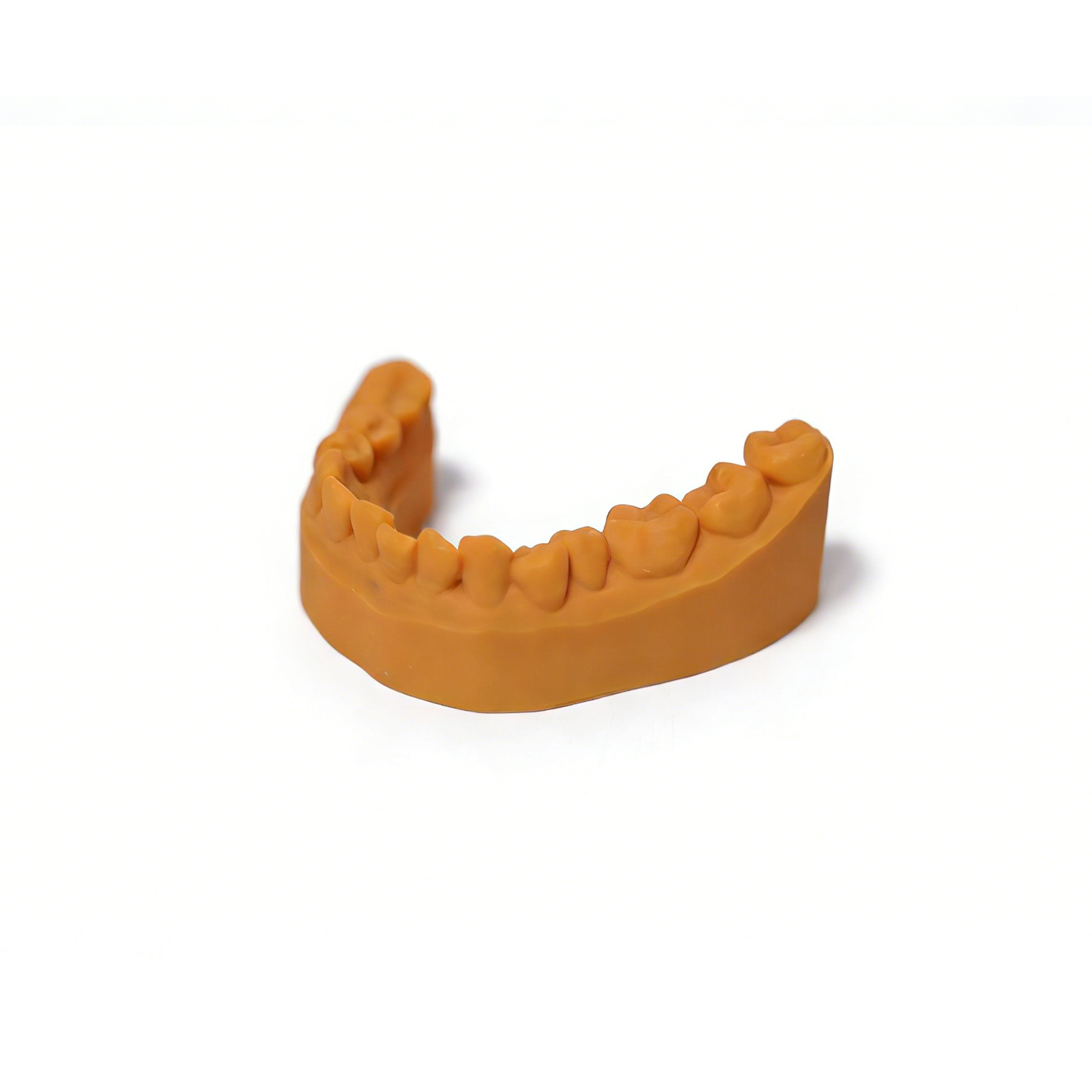
The word “dental” describes a field of use; it does not establish that every printed part is suitable for oral contact. Identify what the finished part will do before choosing the resin.
| Finished part | Role of model-only resin | Material decision |
|---|---|---|
| Study or working model | Appropriate when listed in the resin's intended use. | Select for the model's detail, stability and laboratory workflow. |
| Thermoforming model | Appropriate only when the material supports the forming process. | The printed model stays in the lab; assess the patient-contact sheet and appliance workflow separately. |
| Clinical surgical guide | Do not substitute model-only resin. | Use a material with a surgical-guide indication and its specified processing route. |
| Night guard or splint | Do not select by hardness or appearance. | Use a material indicated for the intended appliance and contact conditions. |
| Temporary crown or bridge | A model for checking a restoration is different from the restoration itself. | Use a material indicated for the actual restoration. |
| Intraoral try-in | A brief fitting check still involves patient contact. | Confirm that the material's instructions cover the specific try-in application. |
Why longer curing does not make model resin mouth-safe
Washing removes surface resin, while post-curing advances polymerization. These steps matter for the finished part, but they do not establish biological suitability for an application outside the material's intended use.
A hard, dry, smooth or odor-free surface cannot demonstrate acceptable oral-contact performance. Biological evaluation considers the finished device, the nature of body contact and the duration of exposure. In the United States, FDA clearance for a dental material is tied to a specific intended use; it is not permission to make any dental device from that material.
Follow the specified wash, drying and curing procedure. Do not invent a longer cycle as a substitute for the required material documentation.
Is a brief intraoral fitting check an exception?
No. Short contact still needs an appropriate material. A model-resin part does not become suitable for a patient simply because it will be removed after a quick fit check.
For example, a crown-shaped demonstration part used on a bench model and a crown-shaped try-in placed over a patient's tooth have different uses. Label demonstration parts clearly and keep them separate from clinical case deliveries.
What about models used to make clear aligners?
In a thermoforming workflow, a suitable dental model resin can be used to print the forming model. A separate sheet is formed over that model to produce the appliance. The printed model and the appliance worn by the patient are different parts.
Confirm that the model resin supports the forming conditions, and follow the model preparation, sheet-material and appliance instructions. A resin being suitable for aligner models does not mean it can be used to directly print an aligner or retainer.
Check these documents before selecting an intraoral resin
Start with the exact product and formulation, rather than a general description such as “biocompatible dental resin.” Ask the supplier for:
Current instructions for use (IFU). Check the named appliance, restrictions and supported contact conditions.
Applicable regulatory documentation. Verify that it covers the exact product and intended use in your market. A generic certificate or an isolated test result is insufficient to establish every application.
The supported manufacturing workflow. Confirm the printer, material profile, washing method, drying, curing equipment and any required disinfection or sterilization procedure.
Handling and traceability information. Keep the safety data sheet, batch number, expiry information and relevant process records.
A technical data sheet describes material properties. A safety data sheet addresses hazards and handling. Neither replaces application-specific instructions. Matching the printer's light wavelength alone also does not establish a supported clinical workflow.
A practical release check for labs using several resins
Use a job record that travels with the part from printing through final inspection. The following is a suggested control method, not a biological safety test:
Keep model-only production separate from patient-contact work. Follow the material manufacturer's requirements for dedicated vats, build platforms, wash solvent and finishing tools; do not assume accessories can be shared after a quick rinse.
Hold the part if its material identity, indicated use or processing record cannot be confirmed. Inspecting fit and surface quality remains useful, but passing those checks does not establish biocompatibility.
Other questions about dental model resin
Can a coating make a model-resin part suitable for the mouth?
Do not assume so. A coating introduces another material and interface. Suitability must be established for the complete finished device and its manufacturing process; a coating's claim alone does not establish that.
Is water-washable dental model resin suitable for oral contact?
Water-washable describes how the resin is cleaned. It does not define its clinical indication. Check the exact product's intended use and processing instructions.
Can I sterilize model resin and use it as a surgical guide?
No. Sterilization does not establish biological suitability or a surgical-guide indication. Use an appropriate guide material and follow its specified manufacturing and sterilization instructions.
Planning a dental model production workflow?
Yidimu dental model resin is intended for model-based laboratory work. Select any patient-contact material separately for its documented application.
To discuss model printing, send Yidimu your model file and production requirements, including the model's purpose, key dimensions, quantity and post-processing needs.