
ABS-Like Resin: Properties, Limits, How to Choose
ABS-like resin is a photopolymer formulated to be tougher and less brittle than standard rigid resin, so a printed part can flex, take a knock, or survive a snap-fit without cracking. It contains no ABS. It's a crosslinked acrylate thermoset, and "ABS-like" is a supplier's label with no standard behind it. Expect it to come closer to molded ABS in impact behavior than in heat resistance, creep, or long-term stability.
What follows is based on general photopolymer behavior, published test data, and YIDIMU material documentation. It applies to rigid, toughened 405 nm resins printed on LCD, DLP, or laser systems. The numbers for any specific resin depend on the printer, the exposure settings, and above all the post-cure, so treat every value as tied to a process.
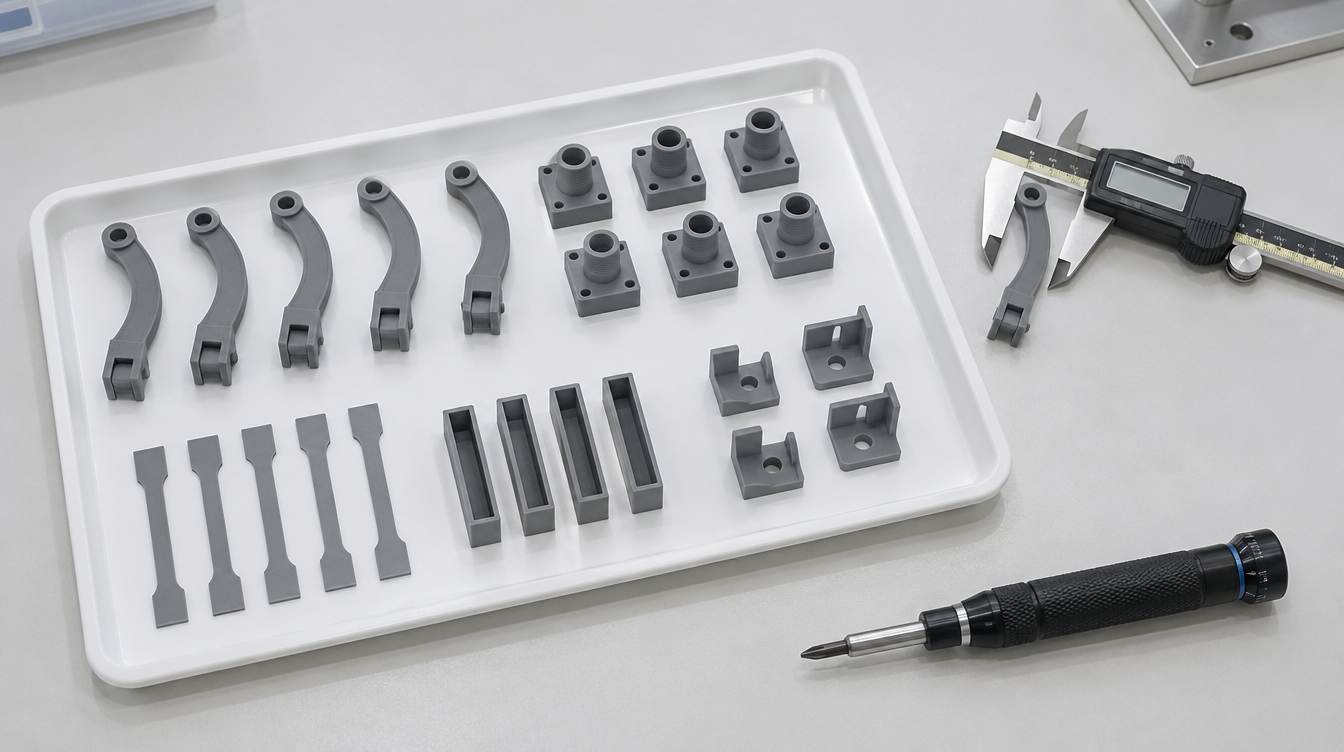
What ABS-like resin actually is
It's a standard acrylate resin with the brittleness formulated down. Standard rigid resins cure into a tightly crosslinked network that is hard and holds fine detail, and that fails by cracking with almost no bending first. ABS-like formulations add softer, more mobile components, which play a role loosely comparable to the butadiene rubber phase in real ABS. The cured part absorbs more energy before it breaks.
The trade-off is built into the chemistry. More give generally means lower stiffness, and often a lower softening temperature. That's why two bottles with the same name can sit far apart: one is barely different from a standard resin, another bends well past the point where you'd expect it to snap.
Two things don't change. The part is still a thermoset, so it won't melt, weld, or reprocess the way ABS does. And it's still a photopolymer, so its final properties are set by how it was cured, not only by what's in the bottle.
How it compares with standard resin and real ABS
ABS-like resin sits between standard resin and molded ABS in toughness, and it doesn't close the gap to ABS in heat resistance or long-term stability. The table shows the direction of each difference. The size of the difference varies by product.
| What you're deciding on | Standard rigid resin | ABS-like resin | Injection-molded ABS |
|---|---|---|---|
| Polymer type | Crosslinked thermoset | Crosslinked thermoset with toughening components | Thermoplastic |
| How it fails | Cracks with little warning | Bends or yields first; the margin varies widely between products | Ductile |
| Stiffness | High, often stiffer than ABS | Usually lower than standard resin, sometimes well below ABS | The reference the name borrows |
| Heat resistance | Moderate | Moderate, typically below ABS | Higher than either resin |
| Sustained load (creep) | Holds shape better than toughened resins, but cracks instead | Takes a set over time under constant stress | Creeps too, with design data available |
| Sunlight and aging | Keeps curing; gets more brittle | Keeps curing; toughness drops unless coated | Degrades in UV unless stabilized or coated |
| Surface and detail | Fine detail, smooth walls | Fine detail, smooth walls | Set by the tool |
Published figures show how wide the label is. In one printer manufacturer's comparison, two ABS-like resins measured heat deflection temperatures of 70 °C and 80 °C at 0.45 MPa, against a literature value of about 100 °C for injection-molded ABS. The same source lists three low-cost ABS-like resins with tensile modulus between roughly 1,000 and 1,600 MPa and elongation at break from 20% to 40%. These are one company's measurements of specific products. The spread is what matters.
Where ABS-like resin works and where it doesn't
It works for parts that get handled, assembled, and occasionally dropped during a development cycle. It struggles with anything that has to carry stress or heat for a long time.
Good fits
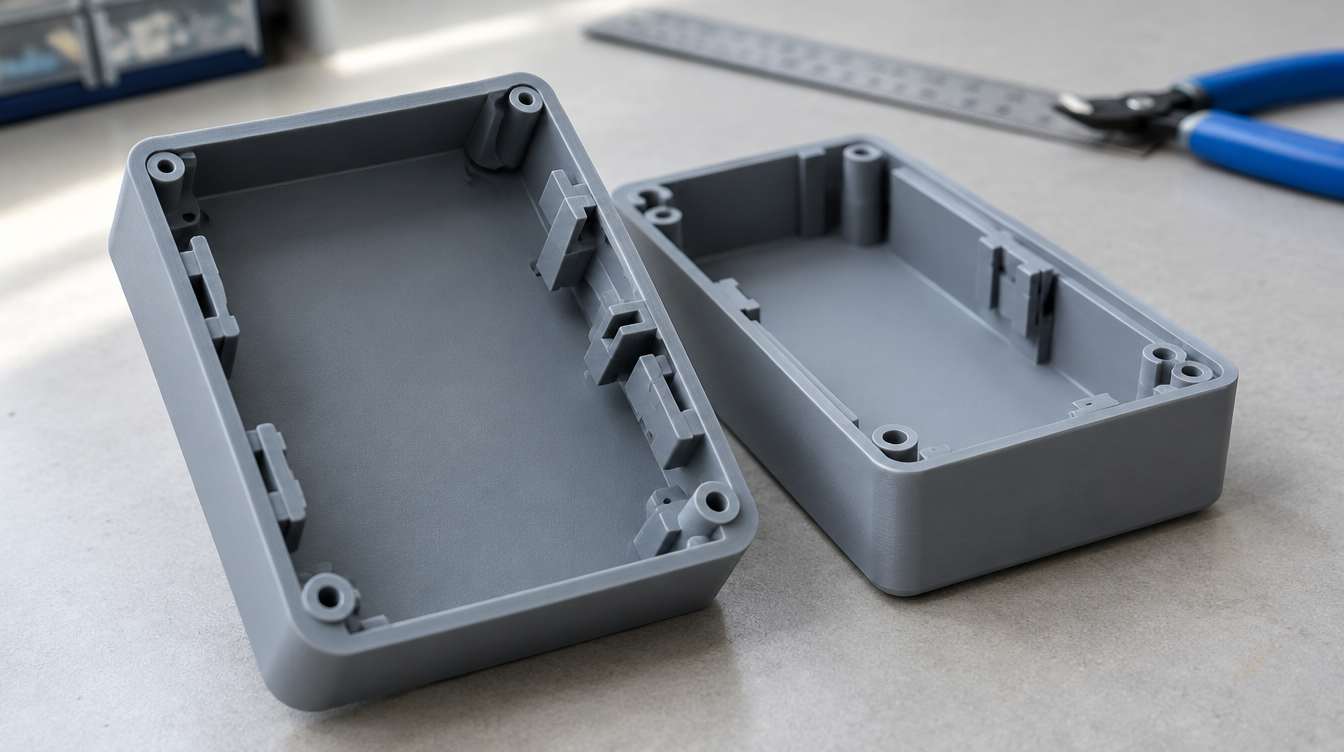
Enclosures and housings with snap-fits, screw bosses, and thin ribs. Drive a self-tapping screw into a standard-resin boss and it often cracks radially; a toughened resin usually takes the thread.
Functional prototypes for assembly checks, where parts are clipped together and pulled apart many times.
Jigs, fixtures, and drill guides that get knocked around on a bench.
Appearance prototypes that have to survive shipping and a review meeting, then be sanded and painted.
Short runs of small parts, provided the low-volume workflow around washing, curing, and inspection is controlled.
Poor fits
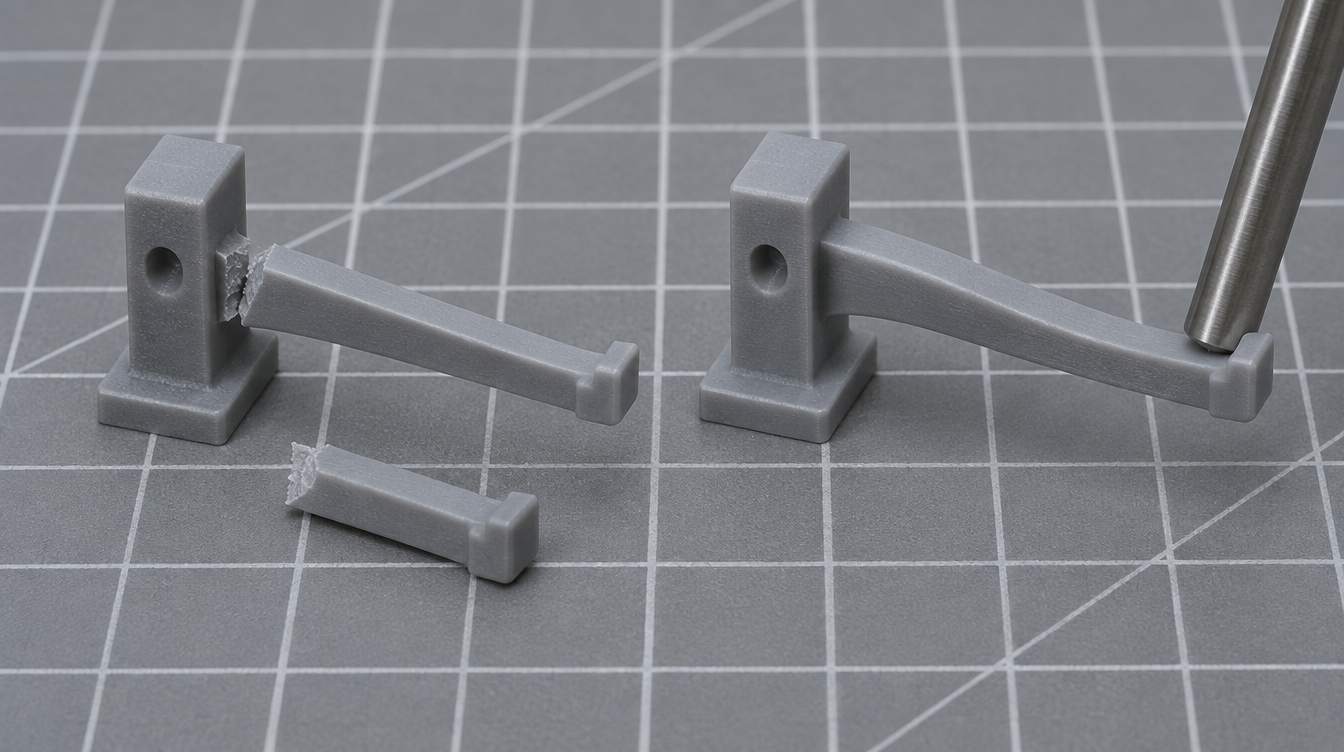
Features under constant stress: a clip held deflected, a press fit, a spring arm. The part takes a set over days.
Warm locations, such as next to a motor, inside a closed vehicle, or through a hot wash cycle.
Outdoor or window-side use without a UV-blocking coating.
Parts that need documented service life over years, or a flame rating. An ABS-like resin doesn't inherit any certification that an ABS grade holds.
Living hinges expected to survive many cycles.
How to read an ABS-like resin datasheet
Elongation at break and impact strength tell you more about toughness than tensile strength or hardness do, and neither means much without the test method and cure condition next to it. Check these before comparing two resins.
Test standard. Tensile values should name ASTM D638 or ISO 527, flexural values ASTM D790 or ISO 178. A number with no method can't be compared with anything.
Notched or unnotched Izod. ASTM D256 uses a notched specimen. Unnotched results run much higher and aren't interchangeable. J/m and kJ/m² results don't convert directly either.
HDT load. ASTM D648 is run at 0.455 MPa or 1.82 MPa. The lower load gives the higher temperature, so check which one is quoted.
Cure state. "Green" and post-cured values can differ substantially. The sheet should give post-cure time, temperature, and equipment.
Specimen details. Print orientation and layer height affect results, especially for impact.
Shore D. A brittle resin and a tough one can both read in the 80s. Hardness says how the surface resists indentation, not how the part breaks.
If a supplier can't tell you the method and the cure condition, the datasheet is a brochure. Ask for a printed sample of your own geometry instead.
Why the same resin gives different parts
Post-cure moves the properties more than most buyers expect. A peer-reviewed study of DLP-printed resins compared no post-cure, UV only, heat only, and UV plus heat, and found the method significantly changed final tensile properties, by an amount that depended on the resin chemistry. Separate work on acrylate resin found that UV post-curing raised strength while lowering toughness.
On the bench this shows up in two ways. Under-cured parts feel slightly gummy, measure soft, and creep. Over-cured parts lose the toughness you paid for, and the snap-fit that passed on day one cracks at the root a few weeks later. Aging continues the same process: in weathering tests, acrylate specimens first got stiffer and stronger, then lost modulus, strength, and elongation as they embrittled.
A few process details matter more with ABS-like resin than with standard resin:
Remove supports before post-cure. Toughened supports tear instead of snapping clean, and they get harder to cut once cured. Use smaller contact tips on cosmetic faces.
Keep solvent wash time to the supplier's limit. A long soak swells thin walls, and fine surface cracks can appear after curing.
Cure thin, flat panels evenly on both faces. Cured from one side, they bow.
Keep the resin within the recommended temperature range. A cold vat thickens the resin and slows reflow between layers.
Sand after post-cure, not before. The green surface clogs paper.
How to qualify ABS-like resin on your own part
Test the feature that will fail, in the real geometry, through the real workflow. Tensile bars tell you about the material; they don't tell you whether your clip survives.
Pick the critical feature: the snap-fit arm, the screw boss, the thinnest wall.
Fix and record the workflow: layer height, exposure, orientation, wash time, drying time, post-cure time and temperature.
Print the feature in at least two orientations.
Cycle the snap-fit, drive screws at assembly torque, and drop the assembled part from handling height.
Hold a loaded feature deflected for several days, release it, and measure how much set remains.
Repeat the tests on parts that have sat for a few weeks in the expected light and temperature.
Measure critical dimensions after post-cure, not straight off the platform.
Run a second build and check that the results hold.
YIDIMU's ABS-like resin
YIDIMU's photopolymer resin range includes an ABS-like 405 nm resin. The YIDIMU catalogue lists Shore hardness of 70–80 D, tensile strength of 30–48 MPa, flexural strength of 40–70 MPa, elongation at break of 11%–20%, and viscosity of 150–300 cps at 25 °C. Read these as catalogue ranges, and confirm the test method and post-cure condition with our application team before using them in a design calculation.
Next step
Send the CAD file for the part you're worried about, with the feature that has to survive marked on it. We can print it in ABS-like resin so you can run the checks above on real parts. Submit your model and requirements.
References
Formlabs, "ABS-Like Resin vs. Real ABS: Properties & Comparisons." https://formlabs.com/blog/abs-vs-abs-like-resin-toughness/
Study of post-cure process and weathering behavior of 3D printable UV-cure resins, 3D Printing and Additive Manufacturing. https://pmc.ncbi.nlm.nih.gov/articles/PMC9828620
"Durability Study of Automotive Additive Manufactured Specimens," SAE Technical Paper 2020-01-0957. https://saemobilus.sae.org/content/2020-01-0957
Zeng, Hsueh, Hsiao, "Effect of ultraviolet post-curing, laser power, and layer thickness on the mechanical properties of acrylate used in stereolithography 3D printing," Materials Research Express. https://doi.org/10.1088/2053-1591/acb751