
LEGO has introduced a tiny 3D-printed piano that produces real musical notes when a flower vase on top is turned. Unveiled on October 15, 2026, as part of the LEGO Icons Venetian Neighbourhood set (11388), the miniature instrument offers a revealing example of how additive manufacturing can bring new functions to consumer products.
The set contains 5,682 pieces and recreates a section of Venice, complete with a canal, gondola, glassblowing workshop, astronomical clock tower and 17 minifigures.
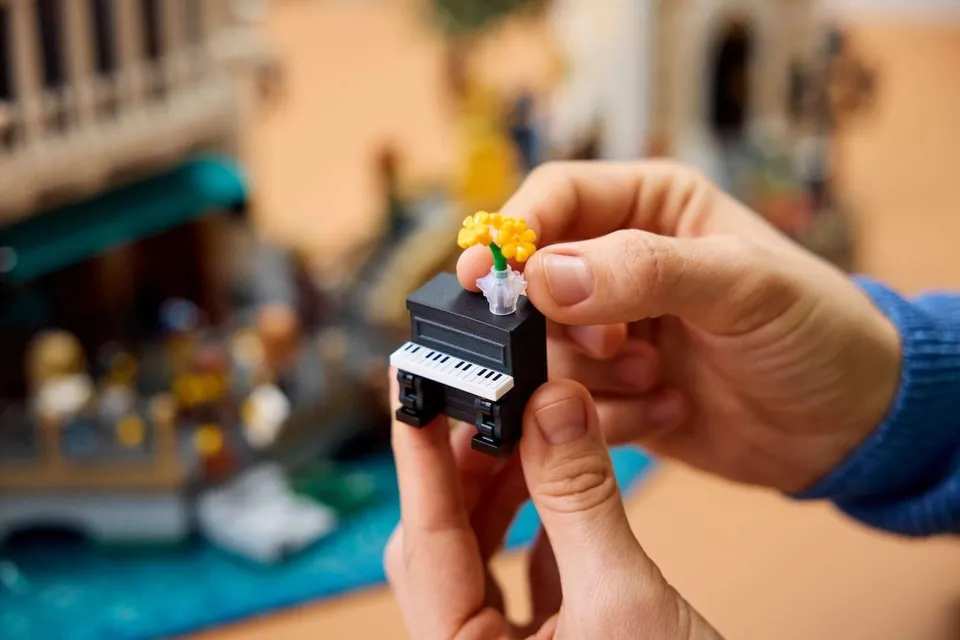
Among those elaborate details is a small black street piano. At first glance, it looks like another decorative element. But turning the flower vase above it activates a mechanism that produces musical notes.
What makes the piano particularly interesting is not simply that it makes a sound. It is a functional 3D-printed component included in a commercial LEGO product.
Why Would LEGO 3D Print a Miniature Piano?
LEGO is closely associated with precision injection molding. The process is exceptionally well suited to producing large quantities of standardized plastic components with consistent dimensions and repeatable quality.
So why use a different manufacturing method for something as small as a toy piano?
The answer lies in what the component needs to do.
According to LEGO, rotating the small flower vase on top of the piano causes it to play actual notes. TCT Magazine also describes a turning mechanism activated by the flower vase.
That functionality introduces design challenges beyond those of an ordinary decorative part.
With conventional injection molding, a complex miniature mechanism may require several individually molded parts that must be assembled afterward. Depending on the design, mold separation, draft angles, undercuts and tool access can limit which geometries are practical.
Additive manufacturing creates different possibilities. Designers can explore intricate internal features and geometries that may be difficult to manufacture as conventional molded components.
However, an important technical distinction remains: LEGO has not publicly detailed the piano's specific 3D printing process or complete internal mechanism.
It would therefore be incorrect to claim that the piano was produced using LCD, SLA, DLP or any other particular process without further technical confirmation. Nor can we assume that every moving feature was printed in a single operation.
The confirmed achievement is the integration of additive manufacturing into a functional element intended for a retail product.
LEGO's 3D Printing Journey Did Not Start With the Piano
The new piano follows another significant development in LEGO's use of additive manufacturing.
In 2025, the company introduced a miniature blue steam train in the LEGO Icons Holiday Express Train set (10361). LEGO identified it as the first 3D-printed element included in one of its retail products.
Unlike a static model, the miniature train features wheels that rotate and a chimney element that moves up and down as the wheels turn.
In an official article published in November 2025, LEGO explained that its additive design and manufacturing team had spent years working toward high-quality production of 3D-printed elements.
The company also made its manufacturing strategy clear: the objective was not to replace injection molding, but to unlock product geometries and functions that conventional manufacturing could not easily deliver.
The transition from a miniature train with moving elements to a piano capable of producing sound illustrates the direction of that work.
These are no longer just printed prototypes used internally during product development. They are components that customers can receive, handle and interact with as part of a finished product.
3D Printing vs. Injection Molding: What Is the Real Difference?
The LEGO piano does not suggest that injection molding is becoming obsolete.
Both technologies have significant manufacturing advantages, but those advantages appear under different production conditions.
| Factor | Injection Molding | 3D Printing |
|---|---|---|
| Design freedom | Subject to mold design, parting, ejection and assembly constraints | Allows complex geometries, subject to process-specific limitations |
| Design changes | May require mold modification or new tooling | Digital designs can often be revised and tested without new tooling |
| Production volume | Typically advantageous for stable, high-volume plastic production | Useful for prototypes, customized parts and selected production applications |
| Tooling requirements | Usually requires dedicated production molds | Often avoids dedicated part-specific tooling |
| Complex functional parts | May require multiple components and assembly operations | May enable structural integration, depending on geometry and process |
| Cost considerations | Tooling costs can be distributed over large production runs | Equipment, materials, build time, post-processing and inspection must be considered |
For a simple plastic component produced in very large quantities, injection molding may offer a lower unit cost and a more established production process.
For a specialized part with complex internal features, low expected demand or frequent design changes, additive manufacturing may offer a practical alternative.
The correct decision depends on geometry, materials, tolerances, required quantity, operating conditions and total production cost.
For a broader comparison, see Yidimu's guide to the advantages and limitations of 3D printing.
Making a Functional Part Is Different From Making a Printable Part
LEGO's miniature piano highlights a challenge that many industrial 3D printing projects encounter.
A successful prototype demonstrates that a concept can be made under a particular set of conditions. It does not automatically prove that the same part can be produced consistently or survive repeated use.
For manufacturers evaluating small functional components, four questions deserve particular attention.
1. Will the moving features operate reliably?
Functional parts need appropriate clearances, stable contact surfaces and predictable mechanical behavior.
Insufficient clearance may cause interference or jamming. Excessive clearance may create looseness, poor alignment or inconsistent movement.
Printed geometry, material behavior, surface finish and post-processing can all influence the final fit.
2. Can the material withstand actual use?
A component that looks correct may still be unsuitable for repeated mechanical contact.
Material selection should consider strength, toughness, wear resistance, environmental conditions and the expected loading pattern.
For photopolymer resin parts, print orientation, exposure settings and post-curing may also affect finished-part performance.
Material datasheets alone do not establish the service life of a specific printed mechanism.
3. Can the same result be produced repeatedly?
Production evaluation requires more than one successful build.
Manufacturers should check whether critical dimensions, assembly fit and operating behavior remain acceptable across representative builds.
Any claimed repeatability should be supported by a defined inspection method and actual production data, rather than inferred from printer resolution.
4. Does the complete process make economic sense?
Printing is only one part of the manufacturing workflow.
Depending on the technology, the process may also require support removal, cleaning, curing, finishing, assembly and inspection.
These operations can affect both part quality and total manufacturing cost, particularly when components are small or contain delicate mechanical features.
Engineering takeaway: Before approving a 3D-printed functional component for production, validate its critical dimensions, mechanical operation, material suitability and consistency across representative builds. A part that prints successfully is not necessarily a production-qualified part.
What Can Industrial Product Developers Learn From LEGO?
One of the most useful lessons from LEGO's experiment is that manufacturing technology can influence what engineers and designers are able to create.
When product development begins with traditional tooling constraints, complex internal mechanisms may need to be separated into several components. Each part may require its own manufacturing and assembly considerations.
Additive manufacturing allows teams to investigate alternative arrangements earlier in the design process.
Several applications are especially worth evaluating:
Complex internal geometry: Components containing channels, cavities or difficult-to-access features.
Functional prototypes: Samples used to evaluate clearances, assembly fit, movement and user interaction.
Rapid design iterations: Products that need repeated mechanical or dimensional revisions before tooling approval.
Customized components: Parts with application-specific geometries or limited production requirements.
Small-batch engineering samples: Parts used for early functional evaluation and production planning.
None of these applications makes additive manufacturing universally superior. The production method must still match the material, mechanical requirements, tolerances and intended use.
Where Does Resin 3D Printing Fit?
The specific additive manufacturing technology used for LEGO's piano has not been disclosed. Its performance should not be attributed to a particular resin printer or printing process.
Nevertheless, the case provides a useful starting point for discussing professional resin 3D printing.
Resin-based processes can be considered for detailed engineering prototypes, complex models, fit-check samples and other applications where fine geometry and surface detail are important.
Whether a resin-printed part can serve as a working mechanical component depends on the resin formulation, loading conditions, component design and validated manufacturing process.
For engineers developing precision components, a representative test print can help determine whether the selected equipment, resin and post-processing workflow are appropriate before moving to a larger production commitment.
That evaluation should include the actual assembly interfaces and critical functional details, not merely a visually attractive demonstration model.
Small Parts Can Reveal Big Manufacturing Possibilities
Large 3D-printed structures often attract attention because of their scale. Buildings, automotive components and complex sculptures provide compelling visual demonstrations of additive manufacturing.
LEGO's miniature piano tells a different story.
Its significance lies not in its size, but in the way manufacturing enables an interactive function inside a compact consumer product.
Following the 2025 miniature steam train, the 2026 piano shows that LEGO continues to explore additive manufacturing as a tool for functional product design.
The broader lesson is not that 3D printing will replace conventional plastic manufacturing. It is that additive manufacturing can expand the range of designs engineers are able to consider.
For manufacturers, the real opportunity emerges when that design freedom is combined with suitable materials, reliable quality control and economically practical production.
Evaluating a complex resin 3D printing project?
Yidimu supports industrial resin 3D printing applications, material selection and sample evaluation. If you are developing a detailed prototype or engineering model, reviewing a representative sample can help identify printing and post-processing requirements before equipment selection.
References
LEGO Group (October 15, 2026).
Ciao, Venice: The LEGO Group floats new Icons set.
Official LEGO announcementLEGO Group (November 12, 2025).
Printer Wonderland: the game-changing technology that just arrived on the LEGO Holiday Express.
Official LEGO manufacturing featureTCT Magazine (October 16, 2026).
LEGO's newest 3D-printed element is a mini piano that actually plays.
Additive manufacturing industry reportBrick Fanatics (October 15, 2026).
New LEGO Icons set includes a 3D-printed piano that plays music.
News coverage and demonstration video